
How Jaipur Logistics Firms Can Use AI Agents for Shipment Tracking

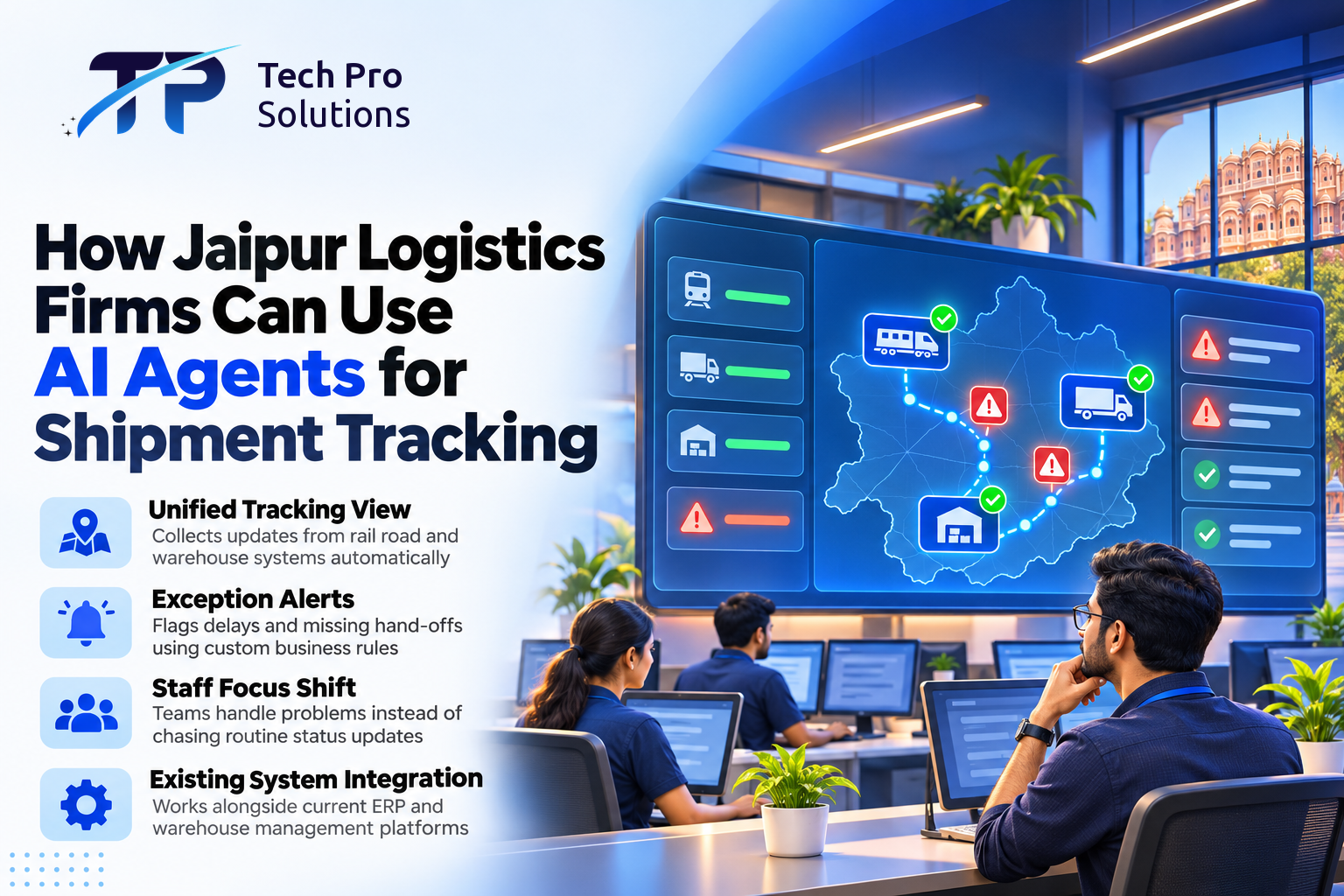
Logistics firms in Jaipur that move goods by rail, by road and through warehouses can find it hard to see where a shipment is, because each leg records its status in a different system. AI agents can collect those updates automatically from carrier systems, the warehouse management system and the firm's enterprise resource planning (ERP) software, which holds its accounts and records, so the operations team can deal with problems instead of chasing updates.
Key Takeaways
- Start with one route and the two sources your team checks most for it.
- Let the agent match events only on exact references, and have an executive approve revised arrival times for clients during the pilot.
- Accidents, theft, off-route stops and temperature excursions go straight to the duty manager, or a named deputy.
The Coordination Problem in Jaipur Multi-Modal Operations
Freight from Jaipur often changes mode on the way. Rajasthan's Logistics Policy 2025 names Sitapura, Vishwakarma Industrial Area (VKIA), Bindayaka, Kukas, Jhotwara and Bagru as the city's industrial clusters for garments, furniture, engineering goods, tableware ceramics and auto components, so a single consignment can start at a factory gate, move by truck and join a train. Phulera is one of the junction stations linking the existing railway network to the Western Dedicated Freight Corridor (DFCCIL), and export cargo can clear customs at Jaipur's Inland Container Depots (ICDs), ICD Sanganer in Sitapura and ICD CONCOR Kanakpura, both live on the ICEGATE 2.0 customs e-filing system (ICEGATE).
Every hand-off logs a tracking event in a separate system: Indian Railways' Freight Operations Information System (FOIS) for rail, each carrier's own portal for road, and the warehouse management system (WMS) for storage. Teams lose hours matching these records by hand while a client asking "where is my consignment?" waits.
How AI Agents Track Shipments Across Rail, Road and Warehouse
An AI agent watches for new tracking data, decides what it means using rules the firm sets, links events from different systems to the same shipment and spots what is missing. A typical workflow runs in six stages:
- Shipment registered: At booking, the agent records the reference number and links it to each system that will report on it.
- Events collected: The agent checks FOIS for wagon-level events where the firm has authorised access, reads vehicle location from carriers that share GPS (satellite positioning) data, and picks up gate-in, storage and gate-out times from the WMS. It connects through application programming interfaces (APIs), the connections that let two programs exchange data, or webhooks, which push a message whenever something changes.
- Events standardised: Each event is converted to one format: what happened, when, where and the status.
- Records checked: The same event from two sources is merged. A record with a missing time or location is flagged as incomplete instead of being guessed, and an event whose match is uncertain (a partial or missing reference) is sent to a person to match.
- Problems flagged: The agent flags problems, often called exceptions. For example, a rail wagon shows "arrived" but no road pickup follows within the set time, or a carrier shows "delivered" but the warehouse has no gate-in.
- Action prepared and approved: For each exception the agent drafts the next step, such as a client update with a revised arrival time or a query to the shipping line. Staff approve it where the firm requires, and the agent sends and logs it.
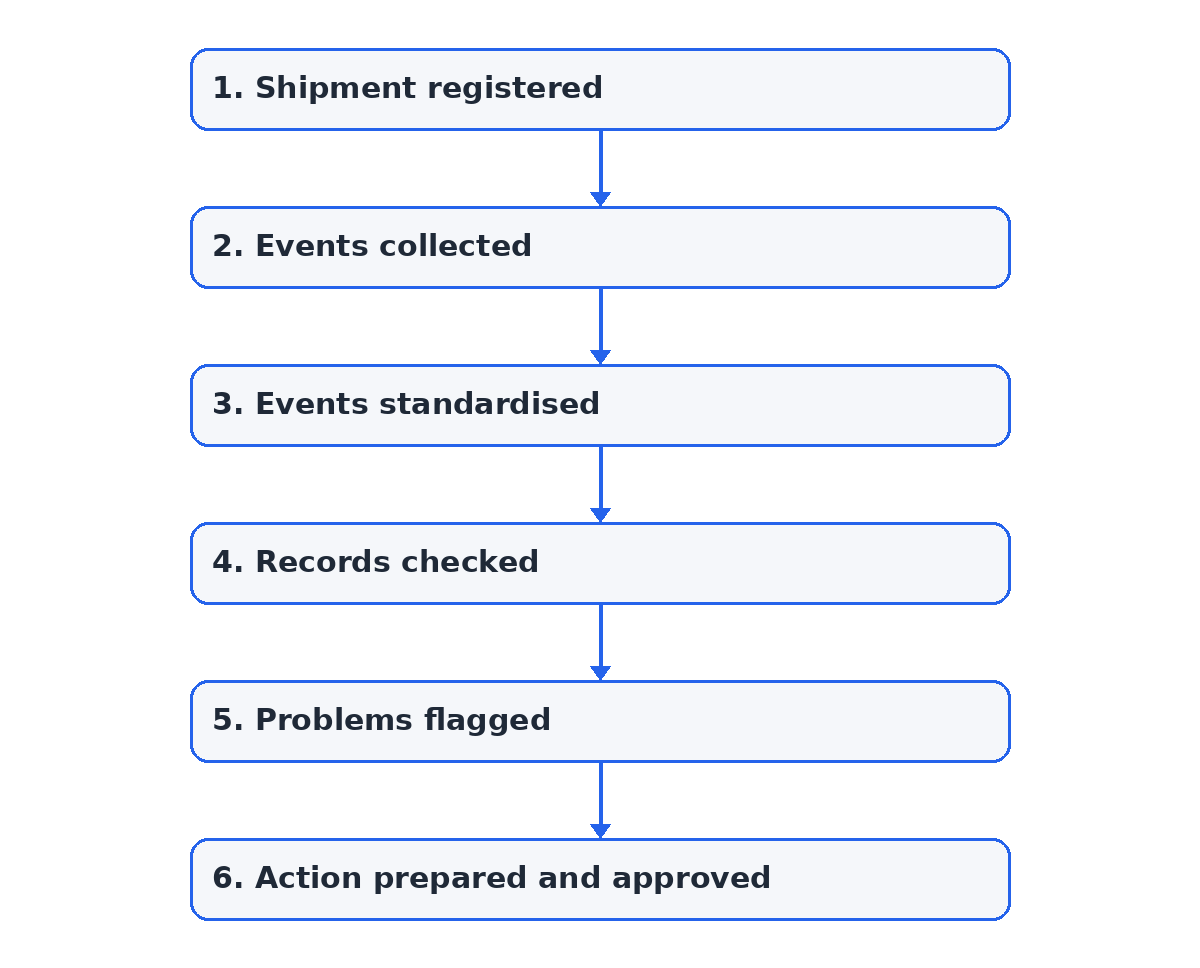 Figure: the 6 main steps, from shipment registered to action prepared and approved.
If a source stops sending data or a login expires, the dashboard marks the affected shipments "not updated" rather than showing stale status, and staff are alerted. Once the connection is back, the agent loads the missed events the source still holds, so any gap stays visible.
AI agents reduce matching errors but do not eliminate them: a revised arrival time is an estimate, and an event can still be linked to the wrong shipment. So the agent matches automatically only on an exact reference, and an executive approves revised arrival times until the pilot has measured their accuracy.
A hypothetical shipment. A furniture load leaves a Sitapura factory by truck for ICD Kanakpura to join a train. The truck's GPS shows it at the depot, but no gate-in appears in the terminal feed within the set time, so the agent flags it and drafts: "Your consignment reached ICD Kanakpura at 3:10 pm. Gate-in is awaiting the terminal's confirmation, and rail departure is now expected tomorrow morning; we will confirm once the terminal records it." The executive checks with the terminal and approves the message.
See how AI Agents connect rail, road and warehouse sources and map which of your systems an agent could read first.
Connecting the Agent to Existing Systems
The agent uses whatever connections the firm's systems already offer, so they rarely need replacing. The four common methods compare as follows.
| Connection method | Best use | Cost and upkeep | Limitations |
|---|---|---|---|
| API or direct connector | Carriers and cloud transport management systems that offer one | One build per connector; light upkeep | Only where the carrier offers one; changes with API versions |
| Webhook listener | Carrier systems that push updates as they happen | Like an API; must run all the time | Needs a scheduled pull as backup |
| Scheduled file transfer or database read | Older on-premise ERPs that can export files | Low build effort | Data is only as fresh as the schedule |
| Browser automation (robotic process automation, RPA) | Carrier or terminal portals with no API | Low build effort but the highest upkeep | Breaks when the portal changes; use only where its terms allow |
Cleaned-up events are kept in one shared record that the client portal, notifications and dashboards all draw on. Three kinds of firm would use it differently (hypothetical examples):
- Freight forwarder or customs broker: would track ICD milestones (gate-in, customs clearance, rail departure) against each export shipment, from file exports of its ERP.
- Third-party logistics (3PL) warehouse: would watch gate-in and gate-out times in the WMS against the hours agreed with each client.
- Fleet transporter: would combine truck GPS with proof of delivery (POD) photos, so a trip closes only when the POD is in.
Working by Exception Instead of Checking Every Shipment
The dashboard sorts shipments into three groups that set the day's priorities.
On-track shipments need no action; routine stage updates go out automatically. The client is told "delivered" only after the POD or the WMS gate-in is recorded; a carrier's "delivered" alone shows as "reported delivered, awaiting confirmation".
At-risk shipments are likely to miss the delivery time agreed with the client. The agent prepares an approved update with a revised arrival time and the reason, so when a rail rake is delayed at Phulera, the consignee hears before they ask.
Blocked shipments cover missing events, carrier disputes and documentation holds. Each goes to an operations executive with the last known location and the documents still needed. A container held at a container freight station (CFS) for customs examination appears here with its bill of entry number, and escalating to the Customs House Agent (CHA) waits for the executive's approval.
High-risk events bypass the queue: an off-route stop longer than the set limit, a driver's SOS, a temperature excursion, an accident, injury, theft or a damage report makes the agent call the duty manager at once, then a named deputy if the manager does not acknowledge within a set time; no client hears of an accident or theft before a manager has handled it.
| The agent handles | Needs operations staff or a customs broker |
|---|---|
| Collecting, matching and standardising events | Revised arrival times for key clients (approval) |
| Flagging exceptions and drafting queries | Carrier disputes, demurrage and detention charges |
| Routine stage updates once confirmed | Loss or damage claims and client disputes |
| Marking shipments "not updated" when a source fails | Customs filings and examination (licensed CHA) |
Cost, Requirements and Setup Phases
An AI agent for shipment tracking has no fixed price: the cost follows the number and type of connections, the complexity of the exception rules and who maintains the connectors.
What Drives the Cost
- Integration build: each connection is a piece of work, and portals that need browser automation cost more to keep running than carriers with an API.
- Exception rules and approvals: each rule (late pickups, missing gate-ins, temperature ranges) is configured and tested.
- Running costs: hosting, AI model calls per event and message charges per client update, which grow with volume.
- Maintenance: updating connectors when a carrier changes its API or portal; agree who owns it.
A worked example (assumed figures, not a result; scope, integrations and volumes change them):
- Setup (assumed): ₹2,00,000 one-off for an agent connected to three or four systems.
- Usage (assumed): 500 shipments a month × 10 events = 5,000 AI model calls × an assumed ₹0.30 per call = ₹1,500; 500 × 4 client updates = 2,000 WhatsApp utility messages × ₹0.115 = ₹230, at Meta's rate for India as listed by Meta for November 2026; prices change.
- Running cost (assumed): ₹9,000 hosting and monitoring + ₹2,000 connector upkeep + ₹1,500 + ₹230 = ₹12,730 a month. Hosting covers the server, uptime alerts and a few support hours; upkeep covers fixes when a carrier changes its system.
- Staff time (assumed): four executives each spend 2 hours a day chasing updates (8 hours). If 70% of shipments run on connected sources and the agent removes 75% of the chasing for those, that frees 8 × 70% × 75% = 4.2 hours a day; less 30 minutes of approvals and review, 3.7 hours. Over 26 working days that is about 96 hours (3.7 × 26 = 96.2), worth 96 × ₹250 an hour (an assumed staff cost) = ₹24,000 a month.
- Value-based payback (illustrative): ₹24,000 − ₹12,730 = ₹11,270 a month, so the ₹2,00,000 setup would be recovered in about 18 months (2,00,000 ÷ 11,270 = 17.7).
The ₹24,000 is the assumed value of staff time; it becomes a cash saving only if staff hours, overtime or hiring actually fall. Not counted here: avoided late-delivery penalties, fewer client status calls and faster dispute handling. Use your own hours and staff costs.
Rajasthan's Logistics Policy 2025 offers eligible logistics projects under the Rajasthan Investment Promotion Scheme (RIPS) a one-time reimbursement of 50% of the cost of logistics management software, up to INR 2,00,000 per installation, and of 50% of the cost of tracking devices, up to INR 2,000 per truck registered in Rajasthan. Confirm eligibility with the state Industries department before counting on it.
What Must Be Ready
- System inventory and data map: every system that creates or uses tracking events, with its shipment identifier, event types and connection method.
- Permissions and logins: written permission to use the rail data feed, and securely stored credentials for each carrier system.
- Exception definitions: what counts as late, missing or held for your business, and who handles each type.
- Volume and client rules: peak daily shipments in festival and monsoon seasons, and which clients get updates by portal, WhatsApp, SMS (text message) or email, in which language. Last-mile alerts to online buyers work as in how Jaipur e-commerce sellers automate delivery tracking.
- A manual fallback: if the agent or a connection fails, staff check FOIS, the carrier portals and the WMS by hand and keep a shared sheet of updates and exceptions until it is restored.
Setup Phases
A discovery workshop walks one live shipment from booking to proof of delivery to find where status goes missing, using sample data with driver and consignee details masked. Connectors are built for the busiest route first, and the agent runs beside manual checks to compare its flags with the team's. As planning estimates: a basic deployment, a dashboard fed by two sources with APIs and no write-back, typically takes 4-5 weeks including the parallel run. Deeper integration (ERP or transport management system write-back, pending FOIS approval, portals that need browser automation) adds about 4-7 weeks, depending on each carrier's API.
Protecting Driver and Customer Data
Tracking data carries personal details: driver names and numbers, consignee details and GPS locations that identify people. Under India's Digital Personal Data Protection Act, 2023 (DPDP Act), personal data may be processed on consent or on a legitimate use listed in Section 7 of the Act, such as data a person gives voluntarily for a stated purpose, a medical emergency or employment. The DPDP Rules, 2025 were published on 13 November 2025, and most of the Act's duties apply from May 2027.
Until then, the data-protection provisions that already apply under the Information Technology Act, 2000 remain in force, including its Section 43A, which the DPDP Act removes only from 13 May 2027 (DPDP Act, Section 44(2), India Code). From May 2027, people must be given the option to read consent notices in English or any language of the Constitution's Eighth Schedule (DPDP Act, Section 5(3)). From May 2027, a business that suffers a personal data breach must tell each affected person and the Data Protection Board without delay, and then send the Board a detailed report within 72 hours of becoming aware of the breach, unless the Board allows more time (DPDP Rules, 2025, Rule 7). Software can support the duties in the DPDP Act, but compliance depends on how the business collects, uses and keeps personal data; confirm obligations with a legal adviser.
In practice, when the agent calls an AI model, send only the fields that step needs, mask driver and consignee names and numbers where possible, and check the model provider's retention terms. Encrypt data in transit and at rest, show personal details only to the roles that need them, and log who views or changes records. If client updates go by WhatsApp, note that with WhatsApp's Cloud API, Meta hosts and processes messages on its servers as a data processor for the business; messages at rest are encrypted and kept for up to 30 days (Meta).
Notice workflow. Before a trip starts, each driver, including drivers of hired carriers (whose contracts should require it), gets a short notice in their language naming the GPS tracking, its purpose, who sees it and how long it is kept. Consignees get a notice and a WhatsApp opt-in through the shipper at booking, and can reply STOP to end updates. Record which notice each shipment's driver and consignee received.
Retention. Keep consignment notes, proof of delivery, customs and goods and services tax (GST) records apart from working data, for the periods your legal adviser confirms. GST records must be kept for 72 months from the due date of the annual return for the year (CGST Act, Section 36). GPS history, agent logs and chat copies are kept for a short period the firm sets and states, such as 90 days (a recommendation, not a legal period).
Next Steps for AI Agents in Logistics Tracking
Pick the route where status checks take your team the most time, connect an agent to the two sources checked most for it, and run it alongside manual checks before adding anything else. Take a baseline from the month before the pilot, then measure against it: the time from an event to its dashboard update, on-time deliveries, client status calls answered from the dashboard, staff hours spent chasing updates, and the events the agent missed. AI agents in logistics pay off when those figures improve without unchecked updates reaching clients.
Frequently Asked Questions
How does an AI agent differ from traditional integration middleware?
Middleware, the software that passes data between systems, moves it on fixed schedules or triggers. An agent also interprets events, links records to the same shipment, estimates late deliveries and drafts the actions the firm has configured, with staff approval where the firm requires it.
What if a carrier will not share its data?
Ask the driver or the carrier's office to send stage updates through a simple form or a WhatsApp template that the agent reads, and mark those shipments as manually reported on the dashboard. Treat data sharing as a term in the next contract renewal.
What happens to our tracking data if we stop using the agent?
Your carrier portals, warehouse system and ERP keep their own records throughout. Before go-live, agree in the contract that the shipment history and exception records it built are handed back in a standard export and that the builder's copies and stored carrier logins are deleted, with written confirmation.
How Tech Pro Solutions Can Help Logistics Firms
Tech Pro Solutions builds AI Agents for freight and warehouse operators. We connect the agent to your carrier systems, rail tracking access, WMS and ERP, write the exception rules and approval steps with your operations head, test them on your recent shipments before any update reaches a client, and maintain the connectors. A basic pilot (a planning estimate): week 1, trace one live shipment; weeks 2-3, connect two sources; weeks 4-5, run beside manual checks with a weekly missed-event report. Client notifications and document collection around the agent can be added with our Business Automation workflows.
Book a tracking workflow assessment with Tech Pro Solutions, and we will map your rail, road and warehouse sources, demonstrate the dashboard on a sample of your recent shipments and estimate the cost for your first route.

About the author
Aniket Kumar · AIML EngineerAniket Kumar works on AI/ML at Tech Pro Solutions, with skills in Python, PyTorch, SQL, LangChain and LangGraph. His LinkedIn profile lists a B.Tech in Computer Science at the University of Engineering & Management (2021–2025).
Comments (0)