
Logistics Automation in Jaipur: How AI Voice Calls Can Cut Delays

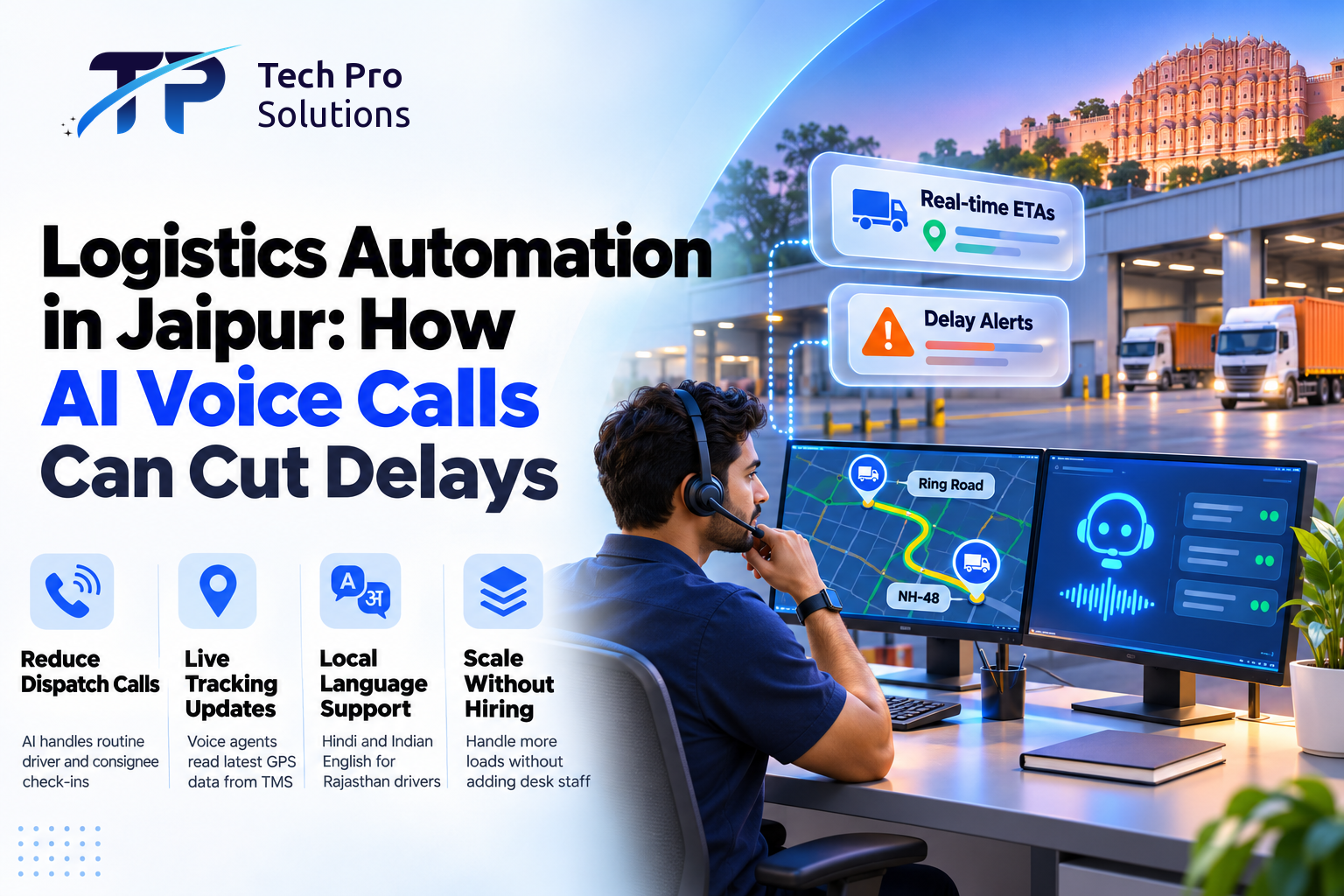
Jaipur logistics automation can reduce transport delays by handing routine dispatch phone calls to an AI voice agent. Connected to fleet tracking, a voice agent gives arrival estimates from the latest data, logs delivery problems that drivers report and alerts warehouse receiving docks before a truck arrives, so the dispatch desk spends its time on the problems that need a person.
Key Takeaways
- AI voice agents take over routine check-calls with drivers and arrival questions from consignees, which eases the morning phone backlog at the dispatch desk.
- Accidents, theft, complaints, rerouting and charges stay with named people; the agent reads key details back and hands over when it is unsure.
The Dispatch Bottleneck: Why Manual Coordination Slows Regional Fleets
Manual coordination slows regional fleets because the dispatch desk becomes a switchboard. Dispatchers spend the morning calling drivers for updates while consignees phone for arrival times. Many trucks carry satellite tracking (GPS) units, but when that data sits in a portal apart from the transport management system (TMS), the dispatch software that tracks consignments and driver assignments, staff still read maps and phone in every update by hand.
Picture a hypothetical carrier based in Sitapura Industrial Area hauling auto components and textiles. The Rajasthan Logistics Policy 2025 names Sitapura, Vishwakarma Industrial Area (VKIA), Bindayaka, Kukas, Jhotwara and Bagru as the Jaipur clusters that generate freight in garments, furniture, engineering goods, tableware ceramics and auto components, so a carrier serving several of them fields calls from many factory managers at once.
Where Logistics Automation in Jaipur Cuts Delays
An AI Voice Receptionist cuts delays in three places: the gap between check-calls, the wait at the dock and the time to clear a reported problem. This post covers the agent placing check-calls and dock alerts; for agents that track shipments across systems, see faster shipment updates with AI agents for Jaipur logistics.
Shorter check-call gaps. The agent calls several drivers at once, up to the number of phone lines set up, and answers consignee calls in parallel, so desk staffing need not rise with volume.
Less dock waiting. When a truck crosses a geofence, a virtual boundary around a delivery site, the agent calls the consignee with a projected dock time, so receiving crews can ready forklifts and labour, which can reduce gate waiting and detention charges.
Faster exception handling. A breakdown or road closure a driver reports goes into the exception log as a structured record, and the operations manager is alerted.
Examples for Three Kinds of Logistics Business
Each is hypothetical and shows where the agent would start, not a result:
- Courier or parcel operator: the agent would call consignees before a last-mile delivery to check someone is in, and log reschedule requests for the hub to approve.
- Full-truckload (FTL) transporter: it would place driver check-calls at planned halts and alert factory docks at the geofence, as for the Sitapura carrier above.
- Third-party logistics (3PL) warehouse: it would take hauliers' calls for a dock slot, read free slots from the warehouse schedule and pass slot changes to the shift supervisor.
How the Voice Agent Handles Dispatch Calls, Step by Step
The AI voice agent reads trip details from the dispatch software, and the tracking platform tells it when a truck crosses a geofence. Outbound check-calls and inbound consignee calls run through one workflow built with Business Automation tools, in four stages:
- Trigger: a geofence event, a scheduled interval or an incoming call starts an update. Repeated triggers for one trip within a short window are set to be merged, so a driver is not called twice for one event.
- Data retrieval: the agent checks the current position and arrival estimate. If the tracking link is down, it is set to say it cannot confirm the position and pass the question to the desk rather than give an old estimate.
- The call: the agent speaks Hindi or Indian English when the chosen speech system supports them (test this with real callers) and asks one short question at a time. When an answer is unclear, it asks the driver to repeat, then hands over to a coordinator.
- Logging: the agent reads back the bilti (lorry receipt, LR) number, location and any reported problem, and the driver hears "logged" only after the TMS confirms the entry; if the entry fails, the agent says the desk will call back and alerts the desk.
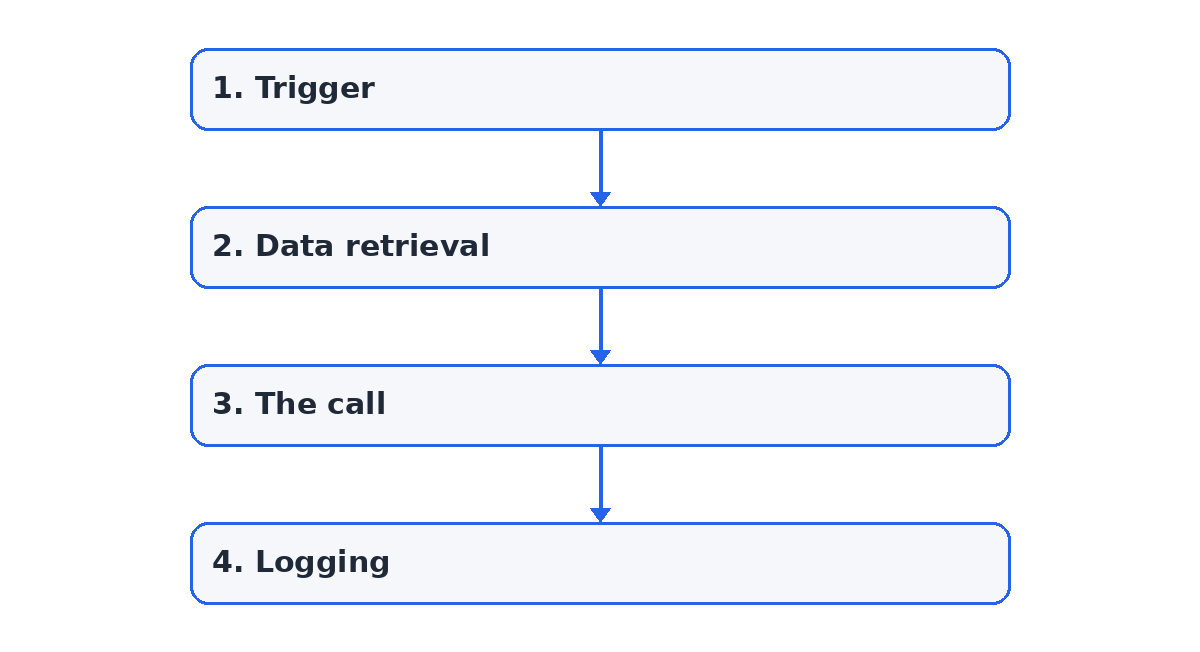 Figure: the 4 main steps, from trigger to logging.
When a call does not go to plan:
- Unanswered calls: a missed call is retried on the fleet's schedule; known dead zones on regular routes are flagged so the agent waits rather than redialling, and repeated failures while a truck sits still outside planned halts become a route exception.
- Human escalation: an accident, injury, fire or theft, whether the driver says "accident", "chot lagi", "aag" or "loot", in Hindi, English or a mix (test the wording with your own drivers), is set to transfer the call immediately to the named duty manager, day or night, or to a named backup if the manager does not answer. If anyone is hurt, the agent tells the caller to dial 108 for an ambulance. Breakdowns and complaints go to an operations manager with the details captured, and any caller who asks for a person is transferred.
| The voice agent handles | Needs a person |
|---|---|
| Arrival estimates from tracking data, labelled as estimates | Rerouting and load changes |
| Driver check-calls at planned halts | Accidents, injuries, theft and police matters |
| Logging a reported delay after reading it back | Detention charges, claims and compensation |
| Dock alerts once the messaging system confirms them | Complaints, reschedules and rate quotes |
The agent can reduce manual note-taking, but speech recognition is not error-free: it can still mishear a bilti number or place name. Google Cloud's Speech-to-Text lists Hindi (India) with telephony models (Google Cloud), so test recognition on your own phone lines with drivers who have agreed to take part, and add terms such as bilti, chowki and godown to the agent's vocabulary. When the agent's confidence is low or a number does not read back correctly, it does not log or answer; it hands the call to the duty coordinator. Review a weekly sample of transcripts.
A Sample Consignee Call in Hindi and English (Hypothetical)
A hypothetical consignee calling a hypothetical carrier; the bilti number, distance and times are hypothetical:
Agent: Namaste, main transport company ka AI voice agent hoon. Call record hoti hai. Aapka number aur bilti is delivery ke liye dispatch team aur is call ko chalane wali services use karengi, jaisa privacy notice mein likha hai; notice SMS par bhej raha hoon. Recording nahi chahiye ya kisi vyakti se baat karni hai toh bataiye. Aage badhein?
Caller: Haan, theek hai.
Agent: Apna bilti number ya registered mobile number bataiye.
Caller: Bilti number 4471. Maal Sitapura se Bagru aa raha hai, kab tak pahunchega?
Agent: Bilti 4471, Sitapura se Bagru, sahi hai? Tracking ke hisaab se truck Bagru se lagbhag 12 kilometre door hai, aur dock par 3:30 baje tak pahunchne ka anumaan hai. Kya main aapke receiving dock ko alert bhej doon?
Caller: Haan, bhej do. Driver ka number mil sakta hai?
Agent: Messaging system ne dock alert bhej diya hai. Driver chalate waqt call nahi lete; zaroorat ho toh main aapko dispatch desk se jod deta hoon.
Caller: Nahi. Lekin kal wala truck bahut late aaya tha, uski complaint karni hai.
Agent: Complaint ke liye main aapko operations manager se jod raha hoon. Aapka bilti number aur ab tak ki baat unhe likh kar mil jayegi.
If the agent or its tracking link goes down, dispatchers return to manual check-calls from a shared trip list and inbound calls ring through to the desk.
Phone, WhatsApp or Chat: Choosing the Channel
Many carriers combine channels:
| Channel | Suits | Cost basis | Needs |
|---|---|---|---|
| AI voice calls | Drivers on feature phones; consignees who want an answer now | Per call minute (telephony plus AI layer) | Automated-call declaration to the operator, tested Hindi recognition |
| Arrival-time links, delivery photos, written records | Per delivered message, at Meta's current rate card | Opt-in, approved templates, a smartphone; not for drivers at the wheel | |
| Website tracking chat | Shippers checking many consignments | Hosting and model usage | A live TMS feed; cannot reach drivers |
| Integrated omnichannel | Customers who use all three | All of the above | The most integration work; one record per trip |
See how an AI Voice Receptionist handles consignee tracking calls before you choose the lanes for a pilot.
What It Costs and How Long Setup Takes
Cost has a one-off part and a running part, and suppliers bundle them differently:
- Telephony: Plivo charges ₹0.38 per minute for domestic inbound and outbound calls and ₹200 a month for a domestic number (as listed on Plivo's pricing page in November 2026; prices change, Plivo).
- The AI layer: speech recognition, the language model and the synthetic voice. A planning estimate from Google Cloud's list prices for speech-to-text, Chirp 3 HD voices, which include Hindi, and a low-cost language model (November 2026; prices change) is about ₹3.44 a minute (US$0.037 at the Financial Benchmarks India (FBIL) reference rate of ₹93.57 per dollar, 17 November 2026, published by the Reserve Bank of India; see its reference rate archive), before goods and services tax (GST) and hosting. With Plivo's call charge, that planning estimate rises to about ₹3.82 per call minute (₹3.44 + ₹0.38 = ₹3.82).
- Integration and upkeep: connecting the TMS, tracking platform and exception log is custom work, cheaper when the TMS shares its data directly than when it only exports files. Upkeep covers vocabulary updates, rule changes and call reviews.
A worked example (assumed figures, not a result). Assume a one-off setup of ₹1,50,000 for one depot connected to the TMS and tracking platform, and ₹10,000 a month for hosting and upkeep (not a quote; scope and volumes change it). For a fleet of 40 trucks with 2 driver check-calls and 1 consignee call per truck a day over 26 days, that is 3,120 calls; at an assumed 1.5 minutes each, 4,680 minutes × ₹3.82 ≈ ₹17,900 in usage (AI layer and telephony). With the ₹200 number rental and upkeep, the running cost is about ₹28,100 a month (17,900 + 200 + 10,000 = 28,100), or about ₹9 a call.
Value (illustrative): by hand, assume each call takes a dispatcher 4 minutes including redials and the agent handles 80% of them without a dispatcher: 3,120 × 0.8 × 4 = 9,984 minutes, or about 166 hours. At an assumed ₹250 an hour, the productivity value of that time is about ₹41,600 a month (9,984 ÷ 60 × ₹250); it becomes a cash saving only if overtime, temporary staff or hiring actually fall. Against the ₹28,100 running cost, that leaves about ₹13,500 a month of value (41,600 − 28,100 = 13,500), a value-based payback of about 11 months (₹1,50,000 ÷ ₹13,500 ≈ 11.1). Not counted here: shorter dock waits and fewer detention charges. Use your own call volumes from current phone records.
For eligible projects under the Rajasthan Investment Promotion Scheme (RIPS) 2024, the Rajasthan Logistics Policy 2025 (clause 5.1.5, Technology Upgradation Incentive), valid until 31 March 2029, offers a one-time reimbursement of 50% of the cost of logistics management software (up to INR 2,00,000 per installation) and of tracking devices (up to INR 2,000 per truck registered in Rajasthan). Whether a voice agent counts as logistics management software, and whether your firm is an eligible logistics project, is decided under RIPS; check both before counting on it.
As a planning estimate, a basic deployment, answering consignee status calls (dispatched, expected delivery day) from a daily TMS export with no live system connection, typically takes 2-3 weeks to a pilot: about 1 week to scope call types, scripts and hand-over rules, then 1-2 weeks of scripting and test calls. Deeper integration with the TMS, adding geofence triggers, exception write-back and dock schedules, adds 1-3 weeks and depends on what the TMS vendor's software allows. A 4-week pilot on one busy lane follows. Before you start, put active bilti and consignee numbers in one database, store every number in +91 format and name a duty manager and backup per shift; legacy software, many subcontracted drivers and patchy coverage make setup longer.
Telecom Rules and Data Protection
Automated calls follow TRAI's rules, and the details they collect are personal data.
TRAI Rules for Automated Calls
Under the Telecom Regulatory Authority of India (TRAI) Telecom Commercial Communications Customer Preference Regulations (TCCCPR 2018), businesses making commercial calls or SMS register with a telecom operator, which records their headers and templates on its Distributed Ledger Technology (DLT) platform. Under TRAI's 2026 amendment to the commercial communication rules, calls placed by software or an artificial voice count as application-to-person (A2P) calls, and a business must declare them to its telecom operator in advance or they are treated as unsolicited (TCCCPR Third Amendment, 2026).
A delivery update to your own customer is a service call that needs no explicit consent, provided it carries nothing promotional; a callback to a consignee who is not your customer counts as a service call only if it is not promotional and the consignee has given explicit consent, valid for seven days or until withdrawn, whichever is earlier (TCCCPR). One way to handle this, as a design choice rather than a TRAI procedure: the shipper records the consignee's consent at booking with the LR, the call follows within the seven days, and drivers get the notice when assigned a trip.
Personal Data: DPDP Act and IT Act
Driver numbers, locations and consignee contacts that identify a person are personal data under India's Digital Personal Data Protection (DPDP) Act, 2023. The DPDP Rules, 2025 were notified in November 2025; most duties, such as notices, security safeguards and breach reporting, apply from May 2027.
Until then, Section 43A of the Information Technology Act, 2000 still applies; the DPDP Act removes it only from 13 May 2027 (DPDP Act, Section 44(2), India Code). Before asking for personal details, the opening line says the call is automated, what it collects, why, who sees it and where the privacy notice is, and continues only with agreement. Anyone can withdraw by saying "calls band karein" or telling the desk; the carrier then stops the calls and deletes or stops processing their details.
A caller who refuses recording is transferred to a coordinator or continues unrecorded, where the phone system allows it. Send the speech and language services only what each call needs. Trip, LR, proof-of-delivery and GST records follow the periods tax law sets; set call recordings, transcripts and driver location history to be deleted after 90 days unless they become part of a dispute or claim file (a period the carrier sets, not a legal one). Encrypt recordings, limit access by role, and review notices with a legal adviser.
Conclusion
Logistics automation in Jaipur works best as a filter: the voice agent takes the predictable calls, and people keep accidents, complaints and judgement calls. Start with a few weeks of phone records to find where check-calls pile up, then pilot on one busy lane, such as Sitapura to Bagru. Before adding lanes, compare against a baseline taken before launch: consignee wait times, on-time deliveries and dock waits, dispatcher hours spent on routine calls, and the hand-over rate.
Frequently Asked Questions
Can it call subcontracted drivers who are not our employees?
Yes, once each driver has been told about the automated calls when assigned a trip and has agreed. The calls reach any mobile, including a basic feature phone, with no app or data needed. Keep their numbers only for the trips they run for you, and let them opt out through the agent or the desk.
What happens to call recordings and trip data if we stop using the service?
Trip records stay in your own transport software, because the voice agent works alongside it. Before go-live, agree in the contract that recordings, transcripts and call logs are handed back in a standard format, or deleted if you no longer need them, and that the provider's copies are removed, with written confirmation.
Who pays detention if the agent's arrival estimate was wrong?
Your existing contracts decide that; the agent changes nothing in them. Its arrival time comes from tracking data that can lag, so the agent calls it an "anumaan" (estimate), not a promise. A dispute over charges goes to the operations manager, with the call log as a record of what was said.
How Tech Pro Solutions Can Help With Regional Logistics Coordination
Tech Pro Solutions, based in Jaipur, sets up an AI Voice Receptionist for transport firms to take consignee tracking calls and driver check-calls. We connect it to your TMS, tracking data and dock schedules, write the Hindi and English scripts, emergency routing and hand-over rules with your operations team, and set up recording notices, access controls and retention for call data. We begin with a demonstration: a sample run of consignee calls on a few of your own past bilti numbers, so your team hears the agent before any build.
Book a dispatch call assessment with Tech Pro Solutions: we will map your check-calls and consignee calls by hour and estimate the setup and monthly cost for your fleet.

About the author
Aniket Kumar · AIML EngineerAniket Kumar works on AI/ML at Tech Pro Solutions, with skills in Python, PyTorch, SQL, LangChain and LangGraph. His LinkedIn profile lists a B.Tech in Computer Science at the University of Engineering & Management (2021–2025).
Comments (0)