
How IT Solutions Help Small Businesses Grow

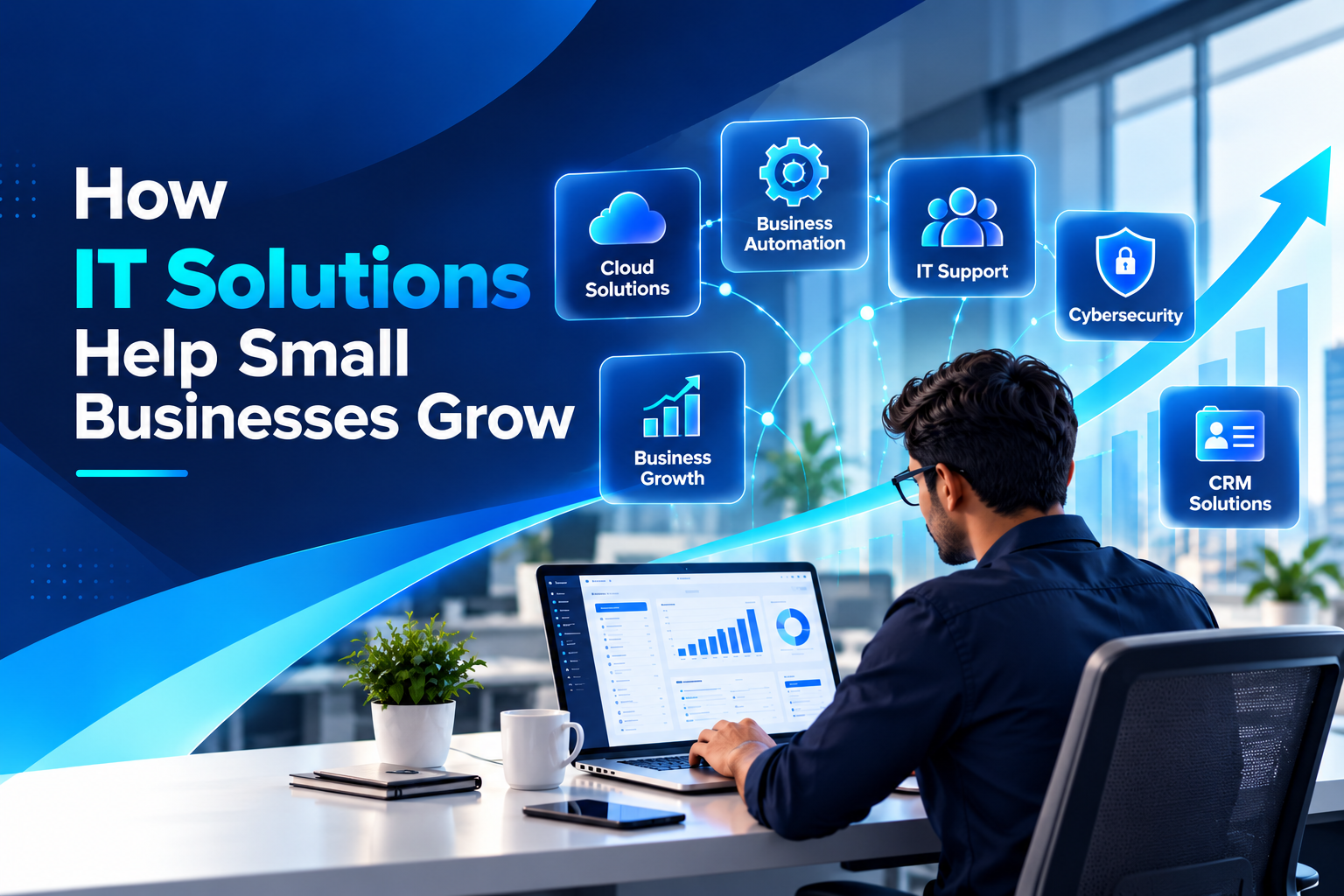
How IT Solutions Help Small Businesses Grow
Technology is now a normal part of running a business. You use email to talk to customers, software to manage accounts, websites to get new enquiries, and online tools to keep your team connected.
But as the business grows, things can get messy.
You may have customer information in one system, sales information in another, files in different folders, and employees using different tools. Your team may also spend a lot of time doing work manually that could be handled by software.
This is where IT solutions for small business can help.
IT is not only about fixing computers when something goes wrong. It can help you save time, keep your information safe, improve customer service, and make everyday work easier.
What Are IT Solutions for a Business?
IT solutions can mean different things depending on the business.
For one company, it might mean setting up cloud software so employees can work from anywhere. For another, it could mean improving cybersecurity or setting up a CRM to manage customers.
Some common IT solutions include:
IT support
Cloud services
Business software
CRM systems
Cybersecurity
Data backup
Network setup
Business automation
IT consulting
There is no single solution that every business needs. A small retail store and a growing software company will have very different requirements.
The important thing is to find technology that solves an actual problem.
Save Time With Automation
Think about the work your employees do every day.
They may enter the same customer details into different systems. They may send the same emails again and again. Someone may spend half a day preparing a report that could be generated automatically.
These jobs take time.
Business automation solutions can handle many of these repetitive tasks.
For example, when someone fills out a contact form on your website, the system can automatically add the person to your CRM, send a confirmation email, and notify the sales team.
Nobody has to copy the information manually.
This doesn't mean employees become less important. It simply gives them more time to work on things that need their attention.
Get Help When Technology Stops Working
Technology problems are frustrating, especially when they stop your employees from working.
A computer stops working. The internet goes down. An employee cannot access their email. A software application suddenly stops working.
If you don't have someone who understands the problem, your employees may spend hours trying to fix it.
IT support for small business can help with these situations.
IT support can cover everyday technical problems as well as software updates, device setup, network issues, backups, and security.
For a small company, having reliable support can be much easier than trying to handle every technical problem internally.
Use the Cloud to Work From Anywhere
Many businesses have moved away from keeping everything on computers in the office.
With cloud services, employees can access files and applications through the internet. This is useful when people work from home, travel, or work from different offices.
For example, a team can use cloud-based tools to share documents, manage projects, communicate, and access important business information.
Cloud solutions for small business can also make it easier to add new employees or increase storage when the company grows.
You don't always need to buy more physical equipment every time your business needs more capacity.
Don't Ignore Cybersecurity
Small businesses sometimes think that hackers only target large companies.
That's not a safe assumption.
Even a small business can have valuable information such as customer details, employee information, payment records, passwords, and business documents.
If that information is stolen or lost, the business can face serious problems.
Basic cybersecurity solutions for small business can include multi-factor authentication, strong passwords, secure devices, regular updates, backups, and access controls.
You don't have to make security complicated. But you should have basic protection in place.
And one of the simplest things you can do is make sure important data is backed up.
Use Your Business Data
Your business already has a lot of useful information.
You know how many customers you have. You know how much you sell. You have website data, enquiries, invoices, customer conversations, and marketing information.
But having data and using data are two different things.
With the right technology solutions for businesses, you can bring information together and see what is happening.
For example, you might find that one marketing channel brings most of your good customers. Or you may notice that many leads are being lost because nobody follows up quickly enough.
These are useful things to know when you're deciding where to spend your money and time.
Give Customers a Better Experience
Customers expect businesses to respond quickly.
If someone contacts you today and your team has to spend ten minutes searching through emails to find their previous conversation, that is not a great experience.
A CRM can help.
A CRM keeps customer information and conversations in one place. Your team can see previous enquiries, follow-ups, purchases, and other details without searching through different systems.
This is one reason business IT solutions can have an effect on customer service as well as internal work.
When your team has the right information, they can respond faster and give customers a better experience.
Don't Buy Technology Just Because It Looks Good
There are thousands of software tools available today.
Every company seems to have a new product that promises to make your business faster, cheaper, or more successful.
But you don't need all of them.
Before buying anything, ask yourself:
What problem will this solve?
If your employees are spending hours creating reports, look for a reporting or automation solution.
If you're losing track of leads, look at CRM software.
If employees cannot access files easily, look at cloud storage and collaboration tools.
If your systems are difficult to manage, talk to an IT consultant.
The technology should follow the business problem—not the other way around.
When Should You Consider Managed IT Services?
As a business gets bigger, managing technology becomes harder.
You may not have enough work to hire a full-time IT employee, but you still need someone to manage your systems.
This is where managed IT services for small business can be useful.
A managed IT provider can look after things such as technical support, system updates, security, backups, networks, and monitoring.
Instead of waiting until something breaks, you have someone looking after your technology on an ongoing basis.
For many small businesses, this can be a practical alternative to building a large internal IT team.
Choosing an IT Company for Your Business
If you decide to work with an IT company for small business, don't choose one simply because it offers the cheapest price.
First, understand what you are actually getting.
Ask about support, security, backups, response times, ongoing costs, and how they will handle problems.
Most importantly, see whether they understand your business.
A good IT provider should be able to explain technical things in simple language. You shouldn't need to be a technical person to understand what you're paying for.
IT Should Support Your Growth
Your technology needs will change as your business grows.
The system that works for five employees may not work for fifty. The way you manage ten customers may not work when you have a thousand.
That's why it's worth thinking about the future when choosing IT solutions for business growth.
You want systems that can grow with you instead of forcing you to start again every few years.
This could mean moving to the cloud, connecting different business systems, improving security, or automating work that is currently done manually.
Final Thoughts
Good technology should make business easier.
It should save your team time, reduce unnecessary work, protect your information, and help you serve your customers better.
You don't need to use every new technology that comes along. Start with the problems your business is facing today.
Maybe your team is spending too much time on manual work. Maybe you have regular IT problems. Maybe your customer information is spread across different systems. Or maybe you're simply finding it harder to manage everything as the business grows.
Those are the areas where IT services for small businesses, cloud solutions, automation, cybersecurity, and IT consulting can make a real difference.
The best IT solutions for businesses are not the ones with the longest feature list.
They're the ones that solve a real problem and make your business easier to run.
Learn how the right IT solutions can help small businesses save time, improve security, support employees, manage customers, and grow more efficiently. From automation and cloud services to IT support, cybersecurity, CRM, and managed IT services, this guide explains how businesses can use technology to solve real problems and work smarter.

Neha - Founder
Comments (0)