
In-House IT Team vs Outsourcing: Which Is Better for a Growing Business?

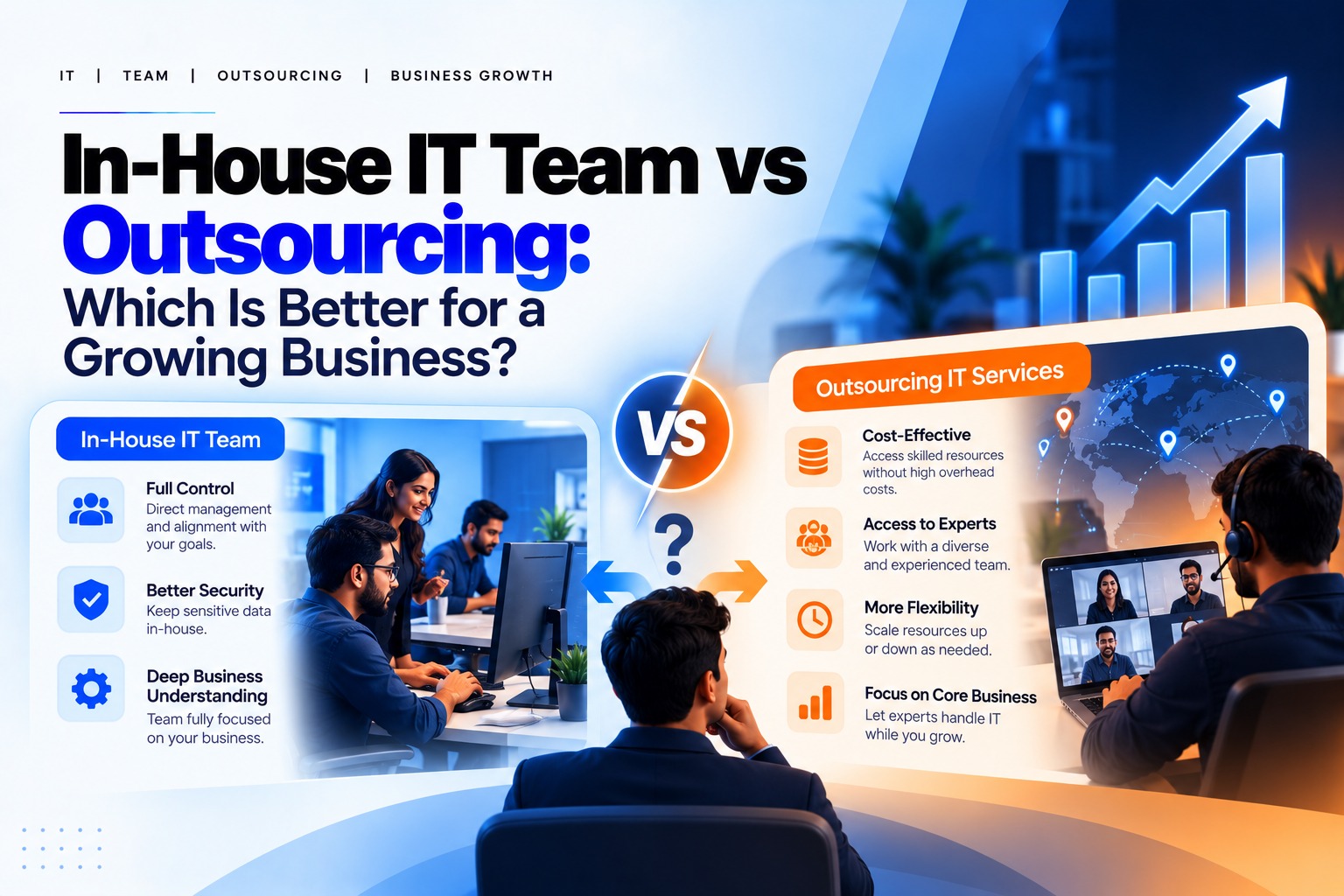
In-House IT Team vs Outsourcing: Which Is Better for a Growing Business?
As a business grows, its technology needs usually grow with it. A company that once managed everything with a few laptops and basic software may eventually need a better website, reliable IT support, stronger cybersecurity, cloud services, and custom software.
At some point, business owners face an important question: should they hire their own in-house IT team or outsource their IT requirements to an external company?
There is no single answer that works for every business. Hiring employees can provide direct control and a team that understands daily operations. Outsourcing can offer access to different technical skills without requiring the business to hire every specialist itself.
The right choice depends on the company's budget, workload, security requirements, and plans for growth. In some cases, combining an internal employee with an external IT partner may be the most practical solution.
Let's compare both options and look at how to decide which approach fits your business.
What Is an In-House IT Team?
An in-house IT team consists of employees who work directly for your company and manage its technology requirements. Depending on the size of the business, this team might include an IT support executive, system administrator, network engineer, software developer, or cybersecurity specialist.
For example, a growing company with 100 employees may need someone to manage laptops, employee accounts, software access, network problems, and internal systems. Having an IT employee available during working hours can make it easier to resolve these everyday issues.
Larger businesses may build specialised teams for software development, cloud infrastructure, cybersecurity, and technical support.
The main advantage is that employees become familiar with the company's systems, working methods, and priorities. However, building a capable team requires more than paying salaries. Recruitment, training, equipment, software licences, and employee retention also need to be considered.
What Is IT Outsourcing?
IT outsourcing means hiring an external company or specialist to handle some or all of your technology requirements.
Instead of employing a full team, a business can work with an IT service provider for tasks such as technical support, website maintenance, software development, networking, cloud management, or cybersecurity.
For example, a small retail business may have someone internally who manages daily operations but no dedicated software development team. If the company needs a new customer portal, it can work with an external development agency rather than hiring developers for a single project.
Outsourcing can be arranged in different ways. A company might hire a provider for one project, pay for ongoing IT support, or use managed IT services under an agreed service arrangement.
The important point is that outsourcing does not automatically mean handing over every technology decision. Businesses can retain control of their goals, budgets, data policies, and approvals while external specialists handle agreed responsibilities.
In-House IT Team vs Outsourcing: Key Differences
Although both approaches can work well, they differ in several important areas.
Cost and Budget
An in-house IT team requires investment in salaries, employee benefits, recruitment, equipment, training, and software licences. If the business needs several specialists, the overall cost can increase significantly.
Outsourcing generally involves paying an external provider through project fees, hourly charges, or a recurring service agreement. This can be useful when a business needs specific skills without hiring permanent employees.
However, outsourcing is not always cheaper. Complex projects, urgent requests, and frequent changes can increase the final cost.
Businesses should compare the total cost of both options over the same period, including support, tools, service hours, and any additional charges.
Technical Expertise
An in-house employee may be experienced in everyday IT support but have limited knowledge of advanced cybersecurity, cloud infrastructure, or application development.
An outsourcing provider may offer access to specialists with different technical skills. This can be useful when a business needs expertise for a particular project without building a complete internal team.
For example, a company planning to launch an e-commerce website may need designers, developers, testers, and security specialists. An external team can provide these skills for the project.
Before choosing a provider, check its actual experience, technical capabilities, references, and delivery process.
Control and Communication
An in-house team works within the company's management structure. Business leaders can assign tasks directly, set priorities, and monitor progress through their existing processes.
With outsourcing, communication needs more structure. The business and provider should agree on the scope of work, project milestones, response times, reporting methods, and approval responsibilities.
For example, if an external company maintains your website, both sides should know who approves content changes, who manages access credentials, and how urgent problems are reported.
Outsourcing can still provide strong accountability, but expectations must be clear from the beginning.
Flexibility and Business Growth
A growing business may need additional technical support, a new website, better networking, or a custom application as its operations expand.
With an in-house team, increasing capacity usually means hiring, training, or reallocating employees. This can work well when the workload is predictable and continuous.
Outsourcing can provide additional capacity for specific projects or temporary requirements. For instance, a business might need developers to build an application for several months but require only occasional maintenance after launch.
The best choice depends on how much work needs to be done regularly and how much is project-based.
Security and Data Protection
Security is important whether IT services are handled internally or externally.
An in-house team may develop a detailed understanding of the company's systems, users, and security policies. However, internal employees alone cannot guarantee protection against cyber threats.
Outsourcing can provide access to specialists who help with system maintenance, security reviews, monitoring, and other technical tasks. At the same time, external providers may require access to business systems or customer information.
Before outsourcing, businesses should review the provider's security practices, access controls, confidentiality terms, data-handling procedures, and incident response process.
Companies should also retain control of essential accounts, documentation, data, and appropriate ownership rights.
Advantages and Disadvantages of an In-House IT Team
An in-house IT team can be a good choice for businesses that need regular technical support and close coordination between IT and other departments.
Its main advantages include direct management, familiarity with internal systems, easier day-to-day communication, and continuity when employees remain with the company.
Internal employees can also develop a strong understanding of business-specific processes and technology requirements over time.
However, there are disadvantages. Hiring skilled professionals can be expensive, recruitment may take time, and one employee may not have the expertise to handle every technical requirement. Businesses must also invest in training and employee retention.
For companies with a steady workload and complex internal systems, these costs may be worthwhile. For businesses with occasional technical requirements, hiring a complete team may not be practical.
Benefits and Risks of IT Outsourcing
IT outsourcing can help businesses access technical expertise without recruiting every specialist themselves.
Some of the main benefits include:
Access to a wider range of technical skills, depending on the provider.
Flexibility to engage specialists for particular projects.
Support for website development, software development, networking, and maintenance.
The ability to expand technical capacity when business requirements change.
Potentially lower staffing commitments for work that does not require a permanent employee.
However, outsourcing also has limitations. Communication gaps can delay work, service quality depends on the provider, and changes outside the agreed scope may cost extra.
Businesses should also avoid becoming completely dependent on one external provider without maintaining documentation and access to important systems.
A clear agreement, regular communication, defined responsibilities, and appropriate security checks can reduce many of these risks.
When Should a Business Outsource IT?
Outsourcing may be worth considering when your business needs technical skills that are not available internally or when the workload does not justify hiring a permanent employee.
It can be particularly useful if:
You need to build a website or application without hiring a full development team.
Your existing employees cannot manage all technical support requests.
You require specialist assistance with networks, cloud systems, or security.
You need external support for a defined project.
Recruitment and training would take too much time for the current requirement.
You want ongoing technical support under a clearly defined service agreement.
For example, a growing professional services company may keep an employee responsible for internal technology coordination while outsourcing website development, maintenance, and selected security tasks.
This arrangement allows the business to retain internal oversight while getting help with work that requires different skills.
Before signing an agreement, confirm the scope, fees, response times, exclusions, data access, and exit arrangements.
When Does an In-House IT Team Make More Sense?
An in-house IT team may be a better choice when technology is central to daily operations and requires continuous attention.
This can apply to businesses with complex internal systems, specialised infrastructure, strict operational requirements, or frequent coordination between technology and other departments.
For example, a company developing its own core software product may need permanent engineers who work closely with product managers and business leaders. Keeping those roles in-house can support continuity and help retain important technical knowledge.
The decision also depends on workload. If a company has enough ongoing work to keep specialists productively occupied, hiring internally may make more sense than paying an external provider for the same recurring responsibilities.
Some businesses will eventually need internal IT leadership even if they outsource technical work. Someone must understand the company's priorities, manage risks, approve expenditure, and ensure providers deliver what was agreed.
Is a Hybrid IT Model the Best Option?
For many growing businesses, the decision does not have to be entirely in-house or entirely outsourced.
A hybrid IT model combines internal employees with external specialists. The internal team manages company priorities, routine coordination, and business-specific knowledge, while external providers handle selected projects or specialist services.
For example, a company might keep an IT administrator on staff and outsource application development, website maintenance, network upgrades, or specialist cybersecurity work.
This approach can provide a useful balance between internal control and external expertise. It can also make it easier to expand technical capacity when requirements change.
However, a hybrid model needs clear boundaries. The business should define who owns each task, who approves changes, where documentation is stored, and how internal staff and external providers work together.
Without those arrangements, responsibilities can overlap or important tasks can be missed.
How to Choose the Right IT Partner
If outsourcing is part of your plan, selecting the right provider matters as much as deciding what to outsource.
Start by listing the services you need and the problems you want to solve. Then evaluate potential providers using these criteria.
Relevant experience: Ask about similar projects and the technical skills required for your work.
Clear pricing: Understand what the quotation includes and which activities cost extra.
Communication: Establish a main contact, reporting schedule, and escalation process.
Security: Review access controls, confidentiality terms, data handling, and incident procedures.
Documentation: Confirm how technical records, source code, configurations, and credentials will be maintained.
Service expectations: Agree on response times, deliverables, maintenance responsibilities, and acceptance criteria.
Exit arrangements: Make sure you can recover your data, documentation, and necessary access if the relationship ends.
It is often sensible to begin with a clearly defined project or service scope, review the provider's performance, and expand the relationship only when it meets your expectations.
Final Thoughts
Choosing between an in-house IT team and outsourcing comes down to the work your business needs, the expertise available, and the resources you can commit.
An in-house team can be valuable for continuous operations, direct coordination, and company-specific systems. Outsourcing can help businesses access specialist skills, complete projects, and manage selected IT responsibilities without recruiting an entire team.
For some companies, the most practical answer will be a combination of both.
TechPro Solutions supports businesses with technology-related services, including website development, application development, IT support, and networking solutions. Businesses considering external support should first identify their requirements, compare the available options, and choose a service arrangement that fits their operational needs and growth plans.
The right IT setup is not necessarily the biggest team or the lowest quotation. It is the one that helps your business operate reliably today while preparing for what comes next.
Frequently Asked Questions
Is IT outsourcing cheaper than an in-house IT team?
It can be, especially when a business needs specialist skills for a limited period. However, the cost depends on the scope of work, support requirements, provider fees, and the total cost of employing internal staff.
Is outsourcing IT safe for a business?
It can be managed securely when the provider follows appropriate security practices and the agreement defines access, confidentiality, data handling, and incident responsibilities. Businesses should assess these arrangements before granting access.
What IT services can a business outsource?
Common examples include technical support, website maintenance, software and application development, network management, cloud services, and selected cybersecurity tasks.
Should a small business hire an IT employee or outsource?
A small business with occasional or specialised IT needs may benefit from outsourcing. If it requires continuous internal support and has enough ongoing work, hiring an employee may be appropriate. A combination can also work.
What is the difference between IT outsourcing and managed IT services?
IT outsourcing is a broad term for using external providers to perform technology work. Managed IT services generally involve ongoing responsibility for agreed systems or support activities under a recurring service arrangement.
Can a business use both an in-house IT team and an external provider?
Yes. A hybrid model allows internal staff to manage business priorities while external specialists support projects or services that require additional expertise. Clear responsibilities and communication are essential for it to work well.
In-House IT Team vs Outsourcing: Which Is Better for a Growing Business?

Neha - Founder
Comments (0)