
How AI Can Help Jaipur Clinics Cut Patient Data Entry Time in 2026

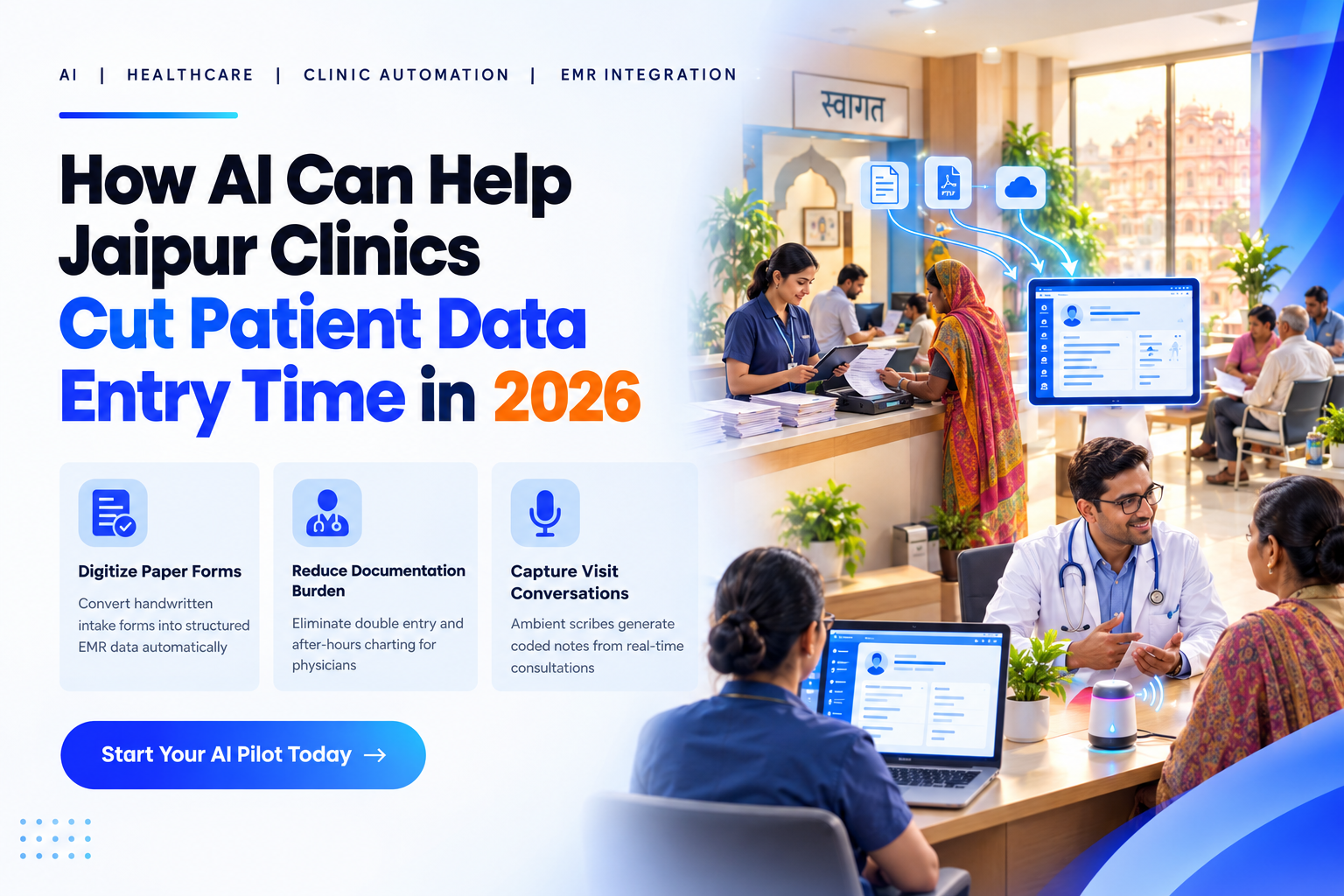
How AI Can Help Jaipur Clinics Cut Patient Data Entry Time in 2026
Paper forms cost Jaipur clinics clinical hours daily. Document intelligence reads the forms, extracts structured data, and syncs it to the EMR automatically. That's the time physicians get back for patients.
Key Takeaways - Paper-based intake forms create after-hours documentation burden that correlates with physician burnout. - Typically, document intelligence pipelines combine optical character recognition with large language models to convert handwritten and printed forms into structured EMR entries. - Ambient clinical scribes reduce documentation time by capturing visit content in real time and generating coded notes. - Integration depth with the existing EMR determines whether the workflow actually saves time or creates new reconciliation steps. - Clinics should pilot on one high-volume form type before scaling across specialties.
Why Paper Forms Still Slow Down Jaipur Clinics
Most outpatient practices in Jaipur still run on paper. Walk into standalone clinics across Malviya Nagar and C-Scheme and you'll see it. Larger facilities near SMS Hospital operate the same way. Printed registration sheets sit on clipboards. Consent forms wait on desks. Clinical assessment templates fill filing cabinets. Patients fill them by hand, often in a mix of Hindi, Marwari, and English. Staff then type the same information into the EMR. That double entry eats hours each week and introduces transcription errors. Research from the National Library of Medicine shows EHR-derived documentation burden drives physician burnout, with after-hours charting strongly correlated to exhaustion (PMC, 2023) Documentation dynamics: Note composition, burden, and physician....
What Document Intelligence Actually Does
Document intelligence ingests scanned or photographed forms, classifies each page, locates fields, reads handwritten and printed text, validates against clinical vocabularies, and pushes structured records into the EMR via HL7 or FHIR. Basic OCR doesn't catch context. This pipeline does. It knows "BP 130/80" belongs in vital signs and "Tab. Metformin 500 mg BD" maps to a medication order.
How Ambient Scribes Complement Form Processing
During the consult, ambient scribes listen. ASR transcribes the conversation. LLMs turn it into a structured note. A paired acoustic stress test on arXiv shows cascading ASR with LLMs handles clinical terms and noise better than dictation alone (arXiv, June 2026) Beyond WER: A Paired Acoustic Stress Test for Ambient Clinical.... Pair form digitization at intake with ambient scribing during the visit and you capture everything without typing. It fits high-volume OPDs in Jaipur: general medicine, pediatrics, orthopedics, where patient throughput is high and consultation time is short.
Integration Patterns That Work
Two integration patterns dominate. One writes discrete data, demographics, allergies, problem list, straight into the EMR database via API. The other just appends a PDF or CDA to the patient chart. Discrete integration powers clinical decision support and reporting, but you'll need vendor cooperation. Document attachment works with any EMR, though data stays locked in a file. MIT News says clinicians using ambient AI co-pilots save documentation time and report lower burnout when output hits structured fields (MIT News, October 2024) Equipping doctors with AI co-pilots - MIT News. In Rajasthan, hospitals run on eHospital (NIC), Bahmni, or custom HIS; check whether your vendor exposes FHIR or HL7 write endpoints before you commit to a document intelligence project.
Preparing Your Clinic Before Implementation
Audit form volume first. You count every new-patient packet, follow-up sheet, and specialty questionnaire the clinic processes each week. Map each form to its destination module in the EMR. Spot fields needing clinical judgment versus pure transcription. Clean up master data: provider lists, diagnosis codes, drug formularies, so the AI maps values correctly. Follow the vendor's capture specs (typically 300 DPI or higher for handwritten forms) and plan for offline-first mobile capture with low-bandwidth sync, since many Jaipur clinics operate on intermittent connectivity. Check if your EMR vendor (eHospital, Bahmni, or custom HIS) exposes FHIR APIs; if not, plan for middleware or vendor coordination.
Choosing a Provider: Questions to Ask
| Capability | Why It Matters |
|---|---|
| FHIR/HL7 write support | Enables discrete data entry, not just PDF attachment |
| Handwritten field accuracy on Indian scripts | Devanagari and mixed-language forms are common in Jaipur |
| On-premise or private cloud option | Data residency requirements under the DPDP Act 2023 and applicable rules may apply; confirm current obligations with legal counsel |
| Human-in-the-loop exception queue | Handles illegible handwriting or missing mandatory fields |
| Training data customization | Learns your clinic's form layouts and local abbreviations |
Ask for a confusion matrix on your own scanned forms. Generic benchmarks don't show where your model fails.
Common Mistakes to Avoid
Buy a standalone OCR tool without EMR integration and you've added a manual step: staff copy outputs from the OCR window into the EMR. Skip consent workflows and you risk compliance trouble. Verify requirements for electronic record creation with your legal counsel or the Rajasthan state health authority. Underestimate change management and adoption suffers. Physicians go back to typing when the AI note needs heavy editing.
Practical Next Steps for Jaipur Clinic Owners
- Quantify the baseline, then you'll measure average minutes per form type and total after-hours charting time per physician per week.
- Select one pilot form: start with new-patient registration in a high-volume specialty. The dermatology clinic in Vaishali Nagar processing 40 new-patient forms weekly makes a solid first pilot for the intake form.
- Run a shadow trial, process last month's forms through the AI in parallel and compare outputs to manually entered records, then calculate field-level accuracy.
- Validate integration, confirm the vendor can write to your EMR's patient demographics, allergy, and problem list modules via FHIR.
How Tech Pro Solutions Can Help
Tech Pro Solutions builds document intelligence pipelines that read paper forms, pull structured clinical data, and push it to your EMR through standards-based APIs. The system handles Indian language handwriting and plugs into major hospital information systems. Human reviewers catch exceptions. Tech Pro Solutions, 6th Floor, Bhamashah Techno Hub, Sansthan Path, Jhalana Gram, Malviya Nagar, Jaipur, Rajasthan 302017. Contact Tech Pro Solutions to discuss a pilot on your highest-volume form via the Document Intelligence service page.
FAQ
Does document intelligence work with Hindi or Marwari handwriting?
Yes, when the model is fine-tuned on local script samples. Accuracy improves with sufficient annotated forms per language; ask the vendor for their data requirements.
Can the system handle checkboxes and diagrams on clinical assessment forms?
Modern multimodal models can detect checked boxes and map body-map annotations to structured laterality fields; capability varies by vendor.
What happens when the AI cannot read a field?
The record routes to a secure exception queue where clinical staff verify or correct the value before it reaches the EMR.
Is patient consent required before scanning forms into an AI system?
Yes; clinics should confirm the specific consent process with their legal counsel or the Rajasthan state health authority.
How long does a typical pilot take?
Timeline depends on form complexity, EMR API readiness, and annotation volume; discuss a realistic schedule with the vendor.
Paper forms cost Jaipur clinics clinical hours daily. Document intelligence reads the forms, extracts structured data, and syncs it to the EMR automatically. That's the time physicians get back for patients.

Tech Pro Solutions - Author
Comments (0)