
Smart Document Search in Jaipur Real Estate: Making Deeds Searchable


If you work in Jaipur real estate, your files probably include stacks of registered sale deeds, lease deeds and conveyance agreements saved as scanned PDF (Portable Document Format) files that no search box can read. Checking past ownership then means someone skimming page after page. Smart document search, built on document intelligence software, can pick out buyer and seller names, consideration amounts and registration dates from those scans and turn them into records you can search.
This kind of tool does not search the government's registration records in Rajasthan; it only covers the scanned files your own firm already holds. A search result is a pointer, not proof: title still has to be confirmed by a lawyer against the original or certified documents and the official records.
Key Takeaways
- Optical character recognition (OCR), which reads text from page images, and language processing turn image-only PDFs into records you can search by name, date or plot number.
- The software picks out party names, registration numbers, consideration amounts and boundaries; Hindi and handwritten text must be tested and checked.
- Search results point your team to the right deed faster; reviewers, lawyers and the Jaipur Development Authority (JDA) keep the decisions that need them.
- Masking, access controls and audit logs support your duties under the Digital Personal Data Protection (DPDP) Act, most of which apply from May 2027 under the DPDP Rules, 2025.
Why Unsearchable Deed Archives Slow Title Checks
Property brokerages, law firms and asset managers keep large collections of title documents: sale deeds, agreements to sell, power of attorney instruments, mutation entries and lease deeds, each with stamps, endorsements and signatures. Because most were scanned or photographed, the computer sees them only as pictures, not as text it can search.
Finding one clause in such a pile can take hours, for example to check whether an earlier owner sold only part of the rights or kept a right of way over an access road. A tired reviewer can miss a restrictive covenant in a side paragraph or misread a handwritten consideration figure.
How Document Intelligence Makes Deeds Searchable, Step by Step
A Document Intelligence system first uses OCR to turn the picture of each page into text, then uses language processing to work out which words are names, dates or amounts and files them in the right fields. Property documents are a hard test: one deed can mix typed English, Hindi clauses, registry stamps and smudged seals, so test a system on your own files first.
A typical pipeline runs in seven stages:
- Files collected and de-duplicated: Scans are gathered from servers and folders; duplicates and blank sheets are set aside so each deed is indexed once.
- Pages cleaned: Skewed pages are straightened, contrast adjusted and show-through ink removed.
- Text read: OCR reads the English and Hindi text, including legible stamps and margin notes. If an outside AI service does this, it receives only the pages it needs, with identity and bank numbers masked where possible.
- Fields extracted: Parties, amounts, dates, plot and khasra numbers and boundaries are picked out; the words around each figure tell the sale consideration from a stamp-duty valuation.
- Uncertain values sent for review: Values the system is unsure about, and unreadable pages, go to a staff member to check against the page.
- Records stored and indexed: Checked values go into the index, each linked to its source page.
- Search and connections: Staff search from an internal screen, and a connected customer relationship management (CRM) system can look up the same records. Failed batches are flagged and rerun, and the screen shows which files are not yet indexed.
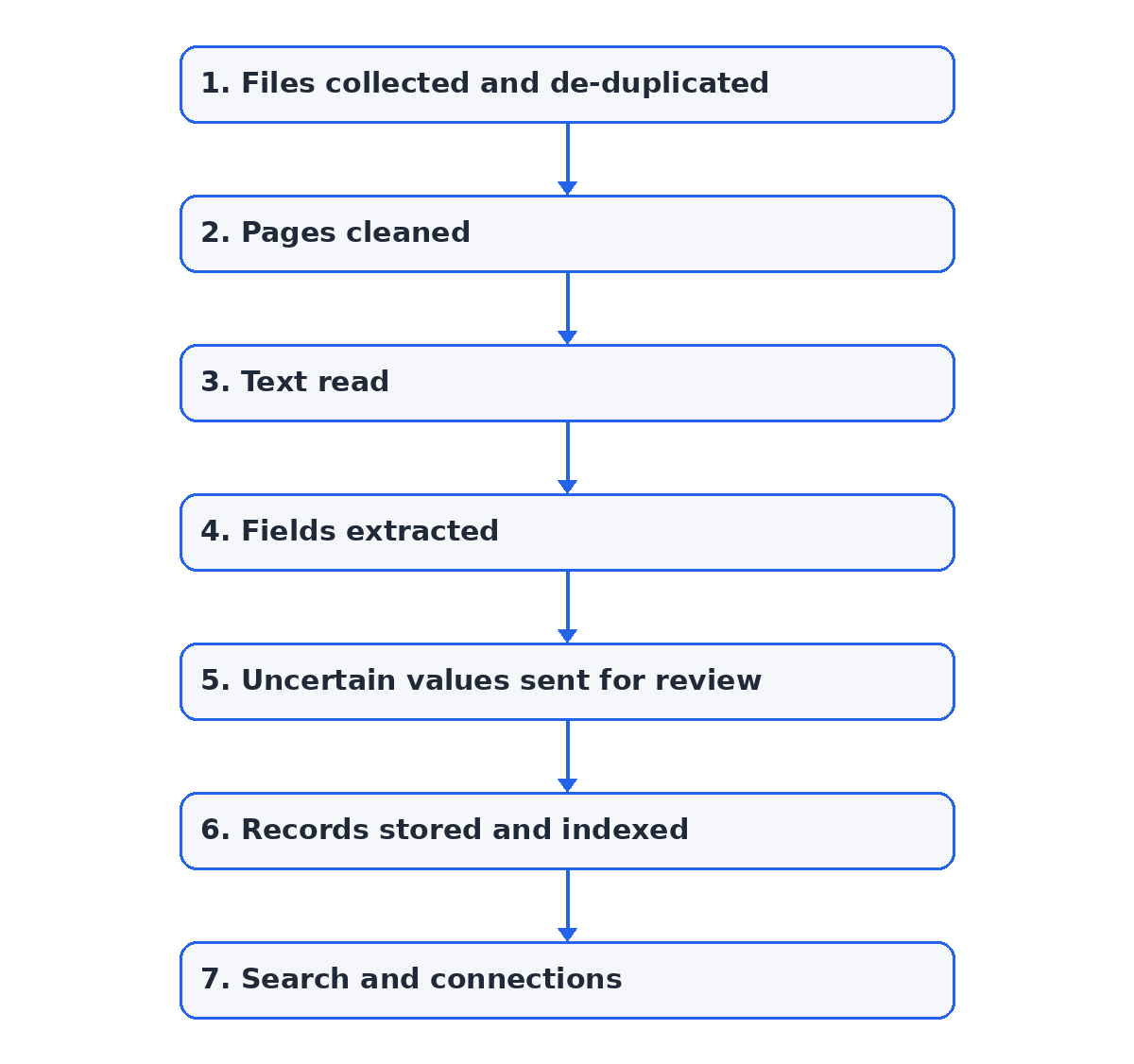 Figure: the 7 main steps, from files collected and de-duplicated to search and connections.
OCR and language processing reduce reading errors but do not eliminate them: even a confidently read khasra number or amount can have two digits swapped. So the system gives every field a confidence score, and anything below the set threshold, or a figure that does not match the same value elsewhere in the deed, goes to a named reviewer instead of the index. Staff also spot-check a sample of high-confidence fields in each batch.
Where the chosen system handles both scripts well, a name can be searched in Hindi or English; test this with names spelt differently in each.
Explore how Document Intelligence extracts deed fields and plan a sample test on your own files before committing to a system.
Turning Deed Text into Searchable Fields
Extracted text becomes useful once sorted into set fields, so staff search by field instead of raw text. The table below is a hypothetical example of how deed text could be sorted for due diligence.
| Attribute category | Extracted data fields | Due diligence purpose |
|---|---|---|
| Registration identification | Sub-Registrar office, book number, volume, page range | Traces where and in what order the deed was registered |
| Instrument chronology | Execution date, presentation date, registration date | Checks the dates of execution and presentation |
| Transacting parties | Transferor names, transferee names, legal representatives | Traces the chain of title and succession |
| Financial consideration | Agreed sale value, stamp duty paid, registration surcharges | Compares past values and the stamp duty recorded on the deed |
| Property demarcation | Locality name, plot number, khasra number, area | Matches the property to revenue and municipal records |
| Boundary schedule | Abutting boundaries (north, south, east, west) | Identifies access roads, adjacent plots and private easements |
With fields like these, brokers and lawyers combine several conditions in one search, such as every conveyance in the archive for a chosen locality, executed between two financial years, with a stated consideration above a set figure.
A hypothetical search, step by step. A lawyer at a Jaipur brokerage types a khasra number and locality into the search screen. Three deeds come back; on the oldest, a seller's name and the consideration amount are flagged as low confidence because the ink is faded. She opens the source page for each flagged field, corrects the name in the review screen and adds the three originals to the title file. Had nothing come back, that would only mean no indexed deed matched: it would not show that the property has no earlier sale or charge.
| The software handles | Needs a staff reviewer, lawyer or official record |
|---|---|
| Finds deeds by name, date, plot or khasra number across indexed files | A staff reviewer confirms every flagged name, amount and plot number against the page |
| Extracts parties, amounts, dates and boundaries, with a confidence score | A lawyer gives the title opinion from the original or certified documents |
| Masks identity, phone and bank numbers in copies to be shared | A person checks each masked copy before it leaves the firm |
| Links each field to its source page and lists files not yet indexed | The JDA or the sub-registrar's office confirms the current official record |
Modernising Jaipur Real Estate Archives with Smart Document Search
Searchable deeds change routine checks: a transaction manager pulls up the clauses on a right of way from a dashboard and passes them to the lawyer, instead of waiting for a clerk to dig out files. Three kinds of firm would use it differently (hypothetical examples):
- Law firm doing a title search: a conveyancing practice would search one khasra number across decades of client files, pull every deed that names it and read those originals for the chain of title.
- Developer aggregating land: a developer buying several adjoining plots for one project might link each seller's deed and boundary schedule to the plot, so gaps in a chain show before the purchase is signed.
- Asset manager holding JDA leases: a firm managing leased commercial property would search lease deeds by lessee and registration date, then confirm the current record with the JDA.
How folder storage compares:
| Factor | Folder storage | Document intelligence |
|---|---|---|
| Search method | Someone opens and reads each scanned page | Search by field, plus text search |
| Indexing | File names and folder paths chosen by staff | Extracted parties, dates and plot numbers |
| Cost basis | Existing storage, plus staff time for every search | Setup, processing charges per page or document (or a software licence), hosting, and review time |
| Limitations and human work | Slow across large archives; easy to miss a clause | Faded, handwritten or Hindi text needs review; extracted values must be checked against the page |
Cost, Requirements and Setup Phases
A deed search system has no fixed price: the cost follows the size and condition of the archive, how many fields you extract and what it connects to.
What drives the cost. One-off work covers scanning paper files, setting up field extraction for each document type, testing Hindi and handwritten deeds, and connecting the CRM or search screen. Running costs are per-page processing charges from a cloud OCR service (or a licence for software on your own servers), hosting, and reviewer time, which falls as scan quality rises.
A worked example (assumed figures, not a quote; scope, connected systems and volumes change it). Assume a one-off setup of ₹1,50,000 for one archive of sale deeds. If 1,000 deeds of 10 pages each are still on paper, scanning at an assumed ₹2 a page adds 10,000 × ₹2 = ₹20,000. Reading the whole back-file of 4,000 deeds (40,000 pages) at an assumed ₹1 per page processed for OCR and field extraction (check the chosen provider's current price page) adds 40,000 × ₹1 = ₹40,000, for an assumed one-off total of ₹2,10,000. Running costs are an assumed ₹8,000 a month: ₹6,000 for hosting and upkeep, plus about 200 new deeds × 10 pages = 2,000 pages × ₹1 = ₹2,000 of processing.
Assume staff look up 120 deeds or clauses a month, taking 1 hour each by hand and 10 minutes with search, and that 80% of look-ups move to search: 96 × 50 minutes = 4,800 minutes, or 80 hours. Subtract an assumed 8 hours a month of reviewer time checking flagged values, leaving 72 hours. At an assumed ₹250 an hour, that time is worth 72 × ₹250 = ₹18,000 a month; it becomes a cash saving only if staff hours, overtime or hiring actually fall. After the ₹8,000 running cost, that leaves ₹10,000 a month of value, so the value-based payback on the assumed ₹2,10,000 one-off cost is about 21 months (₹2,10,000 ÷ ₹10,000 = 21). Not counted: clauses a tired reviewer would have missed and faster closings. This is an illustration, not a result; use your own volumes and staff costs.
What must be ready:
- A list of where deed scans live today, and any paper files still to be scanned.
- A scanning standard, for example at least 300 dots per inch in greyscale or colour, so faint stamps and margin notes stay legible.
- A test sample of clean, faded, Hindi and handwritten deeds, with identity numbers, phone numbers and bank details masked, or deeds whose parties agreed to that use.
- Named reviewers for extracted names, amounts and plot numbers, and agreed access roles.
Setup phases and timeline. Work runs from an archive inventory, through the sample test and agreeing the field list and review rules, to a pilot batch, then the back-file in batches. As planning estimates: a basic deployment, a search screen over clean sale deeds with no CRM connection, typically takes 4-6 weeks from the inventory to the pilot batch, plus scanning time for paper files. CRM integration and a mixed back-file of faded, handwritten or Hindi deeds typically add another 3-5 weeks, depending on whether the CRM can take in outside data. Starting with one document type and fixing the field list early keeps the first phase short.
Data Protection and Governance in Property Documentation
Deeds hold a lot of personal data: full names, home addresses, identity numbers, Permanent Account Number (PAN), payment details and signatures, so India's DPDP Act, 2023 applies to how you handle the scans. The business that decides why and how personal data is used is the Data Fiduciary; a company that processes it on the business's behalf is a Data Processor (DPDP Act, Section 2).
A Data Fiduciary must take reasonable security safeguards to prevent a personal data breach (DPDP Act, Section 8(5)). This duty, like most of the Act's duties, applies from May 2027 under the DPDP Rules, 2025, which were notified on 13 November 2025. Until then, Section 43A of the Information Technology Act, 2000 still applies; the DPDP Act removes it only from 13 May 2027 (DPDP Act, Section 44(2), India Code). Software can support the duties in the DPDP Act, but compliance depends on how the business collects, uses and keeps personal data; confirm obligations with a legal adviser.
In practice, set the system to find and mask Aadhaar numbers, private phone numbers and bank details before deeds are shared with buyers or joint-venture partners, with a person checking each masked copy. Keep audit logs of every search, download and change, encrypt the archive in transit and at rest, and give each staff member access only to the files their role needs.
Notice and consent. Before collecting a new client's deeds, give a short notice (what is extracted, why, who sees it, and a link to your privacy notice) and go ahead once the client agrees. A client can withdraw consent or ask for deletion by writing to a named staff member; the firm then stops processing, keeping only what it must retain by law. For deeds already in the archive, and for sellers, witnesses and other people named in any deed, confirm the basis for processing with your legal adviser.
Retention. Keep two kinds of period apart. Original deeds and client title files follow the firm's legal and professional retention period, which your adviser confirms. The firm sets and states short periods for working data, for example: provider processing copies deleted within 7 days of a batch, the extracted index kept only while its deed file is kept, and search and audit logs kept for 12 months (recommendations, not legal periods).
Conclusion
For firms in Jaipur real estate, start by listing where your deed scans live and running a masked sample of clean, faded, Hindi and handwritten deeds through a candidate system. Take a baseline from your current process before launch and measure the pilot batch against it: turnaround time from a title-check request to the right deed, documents processed and look-ups completed through search, staff hours spent reading and reviewing, and the exception rate (fields sent for manual review or corrected, and personal details the masking missed). Smart document search cuts the hours spent reading files, provided reviewers, lawyers and the official records keep the decisions that need them. If your team also takes buyer calls, AI voice agents for Jaipur property firms can pass title questions to the same staff.
Frequently Asked Questions
Can document intelligence accurately read handwritten clauses in older registered deeds?
Not reliably. Faded or joined-up handwriting is read far worse than typed text. Treat every name, amount and date taken from an old handwritten deed as a draft until someone has compared it with the original page.
Can the system run on our own servers instead of a cloud service?
Yes. OCR and extraction software can be licensed and run on servers you control, so scans never leave the office. You then pay for the licence, hardware and upkeep instead of a per-page charge. A cloud service is quicker to start; check where it stores pages and how soon it deletes them.
What happens to our deed records if we stop using the system?
Your original scans stay yours; a cloud system holds only working copies. Before go-live, agree in the contract that the extracted fields, review notes and logs are returned in a standard export, such as a spreadsheet, and that the provider's copies, including backups, are deleted with written confirmation. The export still works as a basic index.
Can typed files and scanned deeds sit in the same index?
Yes. Typed PDFs and word-processor files already carry text, so they skip OCR and go straight to field extraction. Both kinds then share one index and one set of fields.
Real Estate Document Intelligence with Tech Pro Solutions
Tech Pro Solutions, based in Jaipur, builds Document Intelligence systems for property brokerages, developers and asset managers. We set up field extraction for your deed types, tune how Hindi and handwritten pages are read, build the review screen, set up masking, access roles and audit logs, connect the archive to your CRM or a search dashboard, and keep it running as new deeds arrive. To start, we would set up the field list for your sale deeds and run a pilot batch of masked deeds through the review screen, so your team sees search results, flagged values and source pages on its own files.
Request a deed archive assessment from Tech Pro Solutions: we will demonstrate the search on a masked sample of your deeds and estimate the scanning, setup and running cost.

About the author
Aniket Kumar · AIML EngineerAniket Kumar works on AI/ML at Tech Pro Solutions, with skills in Python, PyTorch, SQL, LangChain and LangGraph. His LinkedIn profile lists a B.Tech in Computer Science at the University of Engineering & Management (2021–2025).
Comments (0)