
How AI in Digital Marketing Can Help Businesses Grow in 2026

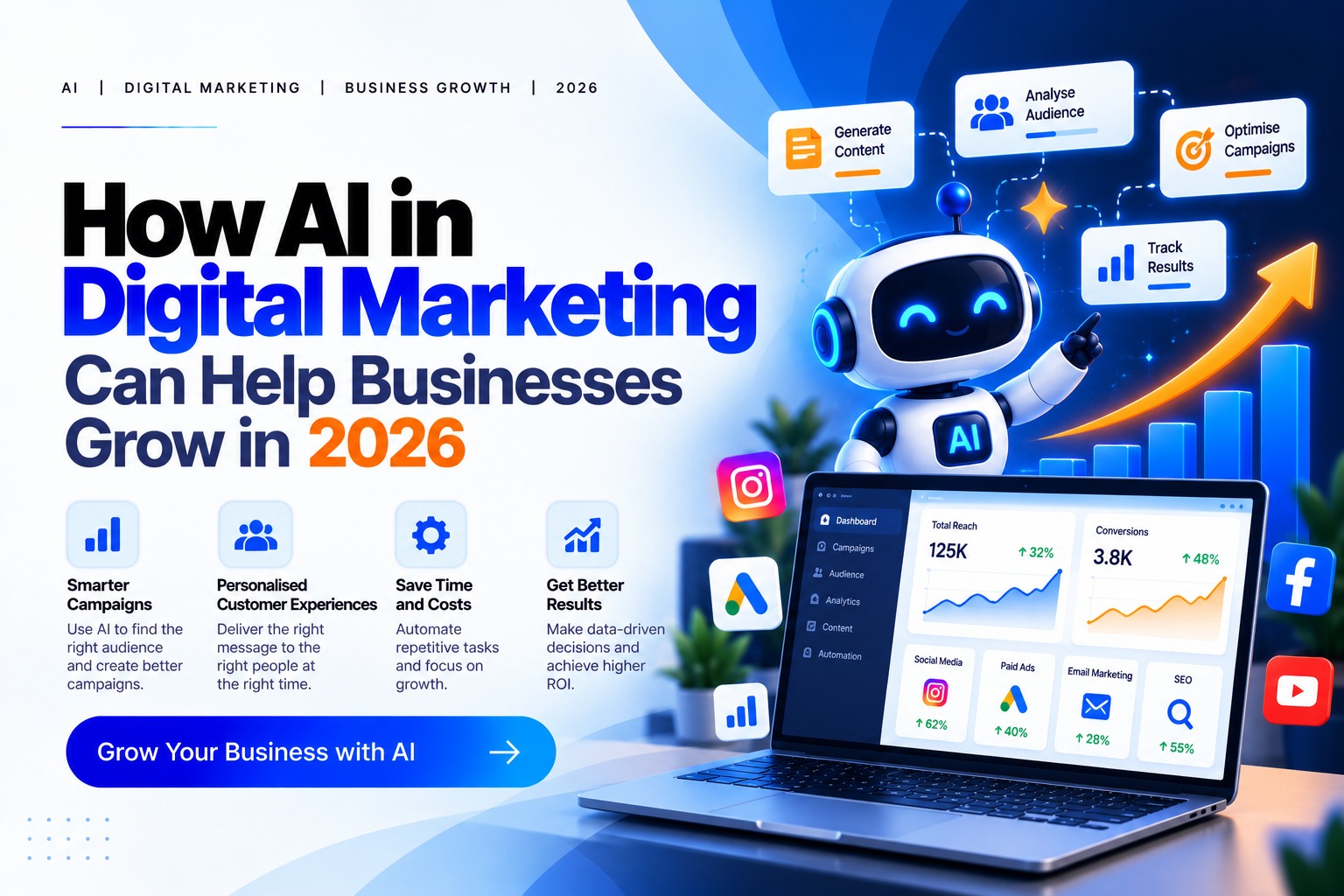
How AI in Digital Marketing Can Help Businesses Grow in 2026
A business can post on social media every day, spend money on Google Ads, and publish blogs regularly without getting enough enquiries. The problem is not always a lack of effort. Sometimes, the business is reaching the wrong audience, using the wrong message, or spending its marketing budget in places that do not bring results.
This is where artificial intelligence (AI) can help.
AI in digital marketing gives businesses more ways to understand customers, improve campaigns, and handle everyday marketing tasks. It can help a small team work more efficiently without needing to do everything manually. However, AI is not a replacement for good marketing decisions. The results still depend on the strategy, the quality of the information being used, and how well a business understands its customers.
So, how can AI help a business grow? Let's look at the practical ways companies can use it in their digital marketing.
What Is AI in Digital Marketing?
AI in digital marketing means using artificial intelligence tools to support activities such as content creation, search engine optimisation (SEO), social media management, online advertising, customer communication, and data analysis.
For example, a company can use AI to identify common customer questions, suggest blog topics, organise incoming leads, or find patterns in advertising performance. Tasks that once required hours of manual work can sometimes be completed much faster.
AI marketing tools are useful because they can process large amounts of information and help marketers make decisions. But they still need human direction. A tool may suggest a topic that looks popular, yet a marketer must decide whether that topic is relevant to the business and its customers.
1. Creating Better Marketing Content in Less Time
Content is a major part of digital marketing. Businesses need website pages, blog articles, social media posts, email campaigns, and advertisements to communicate with potential customers.
Creating all this content takes time, especially for a small business with a limited marketing team.
AI content creation tools can help with the first draft. They can suggest headlines, organise ideas, prepare outlines, and turn a long explanation into shorter social media content. A business can also use AI to develop different versions of a message for different audiences.
Imagine a company that provides website development services. It wants to publish content about the importance of a mobile-friendly website. AI can help create a blog outline, suggest relevant questions, and develop social media post ideas from the same topic.
The marketer can then add practical examples, correct any inaccurate information, and make the writing fit the company's brand.
That final step matters. Publishing the first AI-generated draft without checking it can lead to generic content that sounds similar to hundreds of other websites. The goal should be to use AI to speed up content production, not to publish more content simply for the sake of it.
2. Using AI for SEO and Better Search Visibility
Search engine optimisation helps people find a business when they look for products or services online. But SEO involves much more than adding keywords to a webpage.
A business needs to understand what people are searching for, what information they expect, and why competing pages appear in search results.
AI can support several parts of this process. It can help marketers group related keywords, identify common questions, organise content ideas, and review pages for missing information. Some SEO platforms also use AI to assist with content analysis and technical recommendations.
Consider a local IT company that wants to attract businesses looking for website development services. Instead of writing a general page about web development, the company could research more specific topics, such as website development for small businesses, website maintenance, or the cost of building a business website.
These topics may match different stages of a customer's buying journey.
AI can help organise the research, but keyword suggestions alone will not improve rankings. The content still needs to answer the searcher's question, provide useful information, and offer a good experience on the website.
Businesses should also check page speed, mobile usability, indexing, internal links, and other technical SEO factors. AI can help identify potential issues, but recommendations should be reviewed before changes are made.
3. Making Social Media Marketing More Manageable
Managing social media is not just about posting pictures and captions. Businesses also need to plan content, respond to comments, understand engagement, and maintain a consistent presence across platforms.
AI social media tools can make some of this work easier.
A business can use AI to prepare a weekly content calendar, suggest post ideas, rewrite a caption for different platforms, or summarise engagement data. For example, a single topic about website security could become a short LinkedIn post, an Instagram carousel, and a set of frequently asked questions for the company website.
Each version should be adapted to the platform rather than copied everywhere without changes.
AI can also help a marketing team identify which types of posts receive more attention. If educational posts attract more engagement than promotional posts, the team can test publishing more useful tips and answering common customer questions.
Still, social media works best when a business has something genuine to say. Customers can usually tell when every post feels like a sales pitch. Personal insights, useful explanations, relevant examples, and timely responses help make a brand more approachable.
4. Improving Online Advertising and Marketing Budgets
Paid advertising can bring customers to a business, but it can also waste money when campaigns are poorly targeted or their performance is not monitored.
AI-powered advertising features can help marketers test different messages, identify audience patterns, and optimise campaigns towards selected goals. Advertising platforms may also automate parts of bidding, placement, and creative testing.
For example, a company running Google Ads may discover that one group of search terms brings visitors who spend time on the website, while another group generates clicks but very few enquiries. Reviewing this information can help the marketer decide where to adjust the budget.
AI can assist with analysing campaign data, but businesses should not assume that automated optimisation always produces profitable results. A campaign can generate many clicks without producing valuable customers.
Before increasing advertising spend, businesses should check the quality of leads, conversion rates, cost per lead, and the number of enquiries that turn into sales. These measures provide a more useful picture than clicks alone.
5. Finding and Following Up With Potential Customers
Generating leads is one of the main reasons businesses invest in digital marketing. Yet collecting enquiries is only part of the job. Someone must respond, understand the customer's needs, and follow up at the right time.
AI lead generation tools can help identify patterns in customer behaviour, organise enquiries, and prioritise leads based on relevant information. When combined with a customer relationship management (CRM) system, they can also help sales teams manage follow-ups.
For example, suppose a company receives enquiries through its website, email, and social media pages. Without a clear process, some messages may be missed or answered late. A connected system can bring those enquiries together and help the team track which ones need attention.
AI chatbots can also answer basic questions about services, business hours, or the next steps in an enquiry. More complicated questions can be passed to a human team member.
There is one important limitation: AI cannot make every lead a good lead. Businesses still need to qualify enquiries, understand budgets and requirements, and build trust before expecting a sale.
6. Automating Repetitive Marketing Tasks
Many marketing tasks are important but repetitive. Sending welcome emails, scheduling posts, updating CRM records, and notifying a sales representative about a new enquiry can consume a surprising amount of time.
AI marketing automation can reduce some of this manual work by connecting tools and helping businesses respond to specific actions.
For example, when a visitor submits a website enquiry, an automated workflow could send a confirmation email, add the enquiry to a CRM, and notify the relevant team member. A follow-up message could be scheduled if the process and customer permissions allow it.
Automation can also support email marketing by grouping subscribers according to their interests or previous interactions. A business could send one email to people who downloaded a guide and another to customers who asked for a service quotation.
The important thing is to automate a process that already makes sense. If the original workflow is confusing, automating it may simply make mistakes happen faster.
Businesses should regularly review automated messages, check that customer information is handled appropriately, and make it easy for people to contact a real person when needed.
7. Understanding Customers Through Marketing Data
Digital marketing generates a lot of data. Website analytics show how people use a site, advertising reports show campaign performance, and CRM records reveal how enquiries move through the sales process.
The challenge is turning all that information into useful decisions.
AI analytics tools can help identify trends, summarise reports, and highlight changes that deserve further investigation. A marketer might use them to compare campaign performance, explore why visitors leave a particular page, or find content topics that attract relevant traffic.
For example, a business may notice that a service page receives regular visits but very few enquiry submissions. Rather than immediately spending more on advertising, the team could review whether the page clearly explains the service, displays contact information, and gives visitors a reason to get in touch.
AI may help highlight the problem, but the business still needs to investigate the cause and test improvements.
This is one of the most useful applications of AI in digital marketing: helping teams ask better questions about their results instead of relying on assumptions.
Which AI Marketing Tools Can Businesses Use?
The right tool depends on the work a business needs to improve. There is no single platform that is best for every marketing activity.
Here are a few common options:
ChatGPT: Helps with brainstorming, content outlines, drafting, research questions, and adapting marketing messages.
Canva: Supports the creation of marketing graphics and visual content, including AI-assisted design features.
Google Ads: Offers automated advertising features that help manage campaigns and optimise performance.
Google Analytics: Helps businesses understand website traffic, user behaviour, and conversions; AI-assisted insights may be available depending on the features in use.
HubSpot: Provides CRM, marketing automation, email marketing, and AI-assisted features within its platform.
Before choosing a tool, consider its cost, integrations, learning curve, privacy practices, and whether it solves a real problem. Starting with a few tools that work well together is often more useful than subscribing to many platforms at once.
How Small Businesses Can Start Using AI in Digital Marketing
A business does not need to change its entire marketing strategy overnight. A gradual approach makes it easier to see what works and avoid unnecessary spending.
Start with one problem. Identify the task that takes too much time or produces disappointing results. It might be writing content, responding to enquiries, or understanding advertising performance.
Choose a suitable tool. Look for a tool that addresses that specific problem. Check its pricing, limitations, and whether it works with the systems you already use.
Keep a human review process. Check facts, brand tone, customer messages, and important decisions before publishing or sending anything. Avoid entering confidential customer or business information into tools without checking their data-handling terms.
Measure the outcome. Compare the results with your starting point. Did content production become faster? Did response times improve? Did more website visitors submit enquiries? The answer should come from actual results.
Improve gradually. If the first use case works, expand to another area. If it does not, review the process before investing more time or money.
This approach helps businesses use AI for growth without treating it as a shortcut to instant results.
Common Mistakes to Avoid When Using AI for Marketing
AI can be useful, but poor implementation can create new problems.
One common mistake is publishing AI-generated articles without adding original insight or checking facts. This can lead to repetitive content that offers little value to readers.
Another mistake is focusing on traffic instead of business outcomes. A campaign may attract thousands of visitors but still fail to generate relevant enquiries.
Businesses can also become too dependent on automation. An automated response may be suitable for a simple question, but a customer with a specific problem may need personal assistance.
Finally, companies should not assume that every AI recommendation is correct. Tools can misunderstand context, produce inaccurate information, or suggest actions that do not suit the business.
The safest approach is to treat AI as a support system. People should remain responsible for the strategy, quality, customer relationships, and final decisions.
How Can AI in Digital Marketing Help a Business Grow?
AI can support business growth by helping marketing teams work more efficiently, understand customer behaviour, improve campaigns, and manage enquiries. But its value depends on how well it is connected to the business's goals.
For one company, the biggest opportunity may be improving SEO and attracting more relevant website visitors. For another, it may be responding to leads faster or reducing the time spent preparing social media content.
Businesses exploring these opportunities can start by reviewing their current website, marketing activities, customer journey, and lead management process. This helps identify where technology can make a meaningful difference.
At TechPro Solutions, businesses can explore services such as website development, digital marketing, and AI solutions based on their needs. The first step is not to adopt every new tool; it is to identify a real business challenge and choose a practical way to address it.
AI is most useful when it supports a clear plan, gives people better information, and leaves room for human judgement. Used thoughtfully, it can become a valuable part of a business's long-term digital marketing strategy.
How AI in Digital Marketing Can Help Businesses Grow in 2026

Neha - Founder
Comments (0)