
AI Automation vs. Traditional Automation: What Is the Difference?

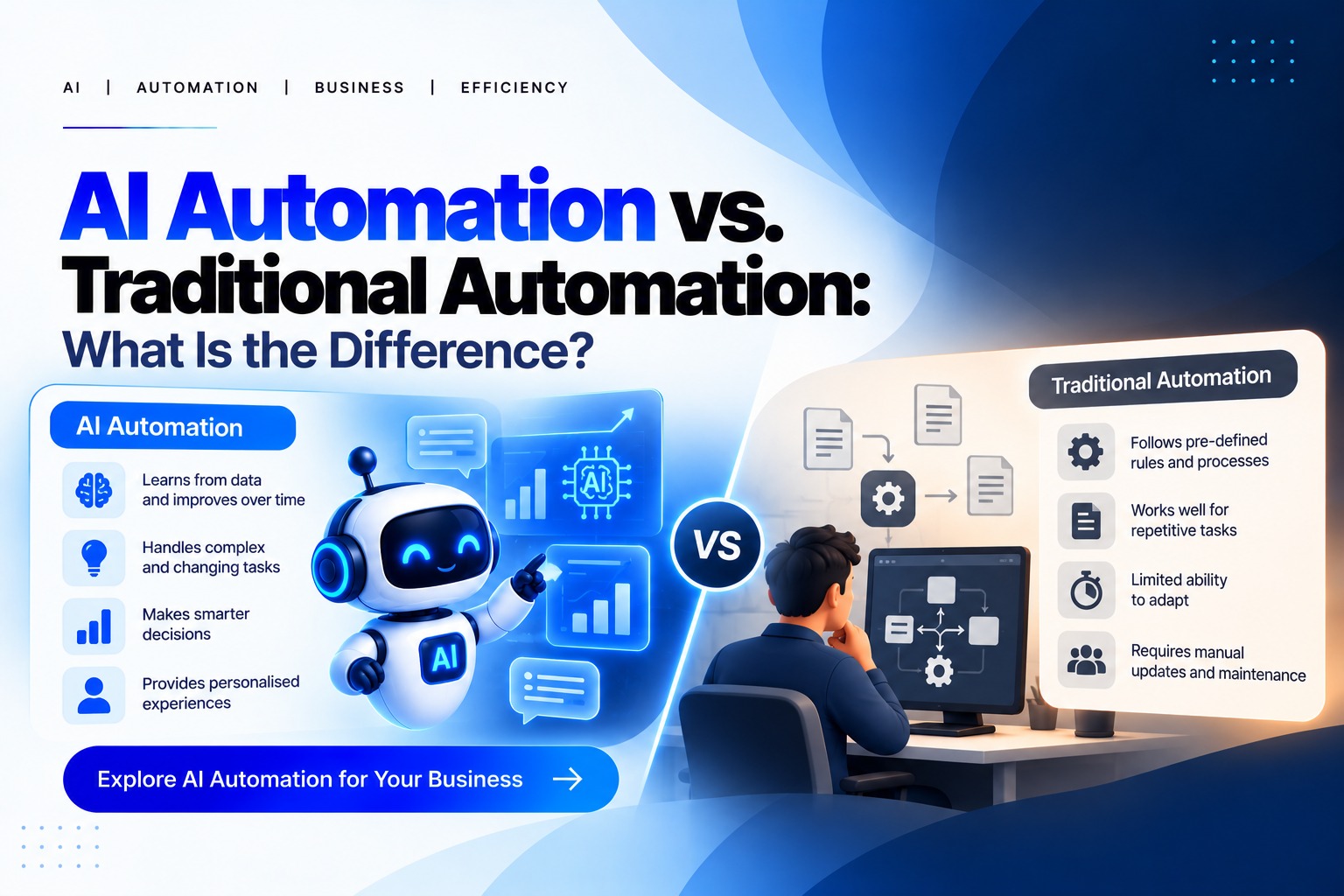
AI Automation vs. Traditional Automation: What Is the Difference?
Businesses are always looking for ways to save time, reduce repetitive work, and improve productivity. Automation helps achieve these goals by allowing software to handle tasks that would otherwise require manual effort. However, not all automation works in the same way.
Traditional automation follows predefined rules and instructions, while AI automation uses artificial intelligence to interpret information, recognize patterns, and support more flexible workflows.
Understanding the difference between AI automation and traditional automation can help businesses choose the right technology for their needs. In some cases, a simple automated workflow is enough. In others, AI can make a process more efficient by handling information that is difficult to manage with fixed rules alone.
This article explains how both approaches work, their benefits and limitations, and how businesses can decide which one to use.
What Is Traditional Automation?
Traditional automation uses predefined rules to complete tasks automatically. Once a workflow is set up, the software follows the same instructions whenever the required conditions are met.
For example, a business can set up an automated email reminder that is sent three days before an invoice becomes due. Once the rule is configured, the system sends the reminder without an employee needing to remember or complete the task manually.
Traditional automation works best when a process is repetitive, predictable, and follows a clear sequence of steps.
Businesses commonly use it for sending email notifications, scheduling appointments, updating customer records, generating regular reports, and transferring information between applications.
Benefits of Traditional Automation
One of the main advantages of traditional automation is its predictability. Because the workflow follows predefined instructions, businesses can usually understand what will happen under specific conditions.
It can also be relatively easy to implement for straightforward tasks. A company does not need a complex AI system to send reminders, update a spreadsheet, or generate a standard report.
Traditional automation also helps reduce human error in repetitive tasks. When a process is configured correctly, it can perform the same steps consistently and free employees to focus on other responsibilities.
Limitations of Traditional Automation
Traditional automation has limitations when a task requires interpretation or when information changes in unexpected ways.
For example, a basic email automation system may sort customer messages using specific keywords. If a customer describes a problem using unfamiliar wording, the system may not route the message correctly.
Businesses can add more rules to handle additional situations, but maintaining complicated workflows can become difficult over time.
This is why traditional automation is most effective for tasks with clear rules, consistent inputs, and predictable outcomes.
What Is AI Automation?
AI automation combines automated workflows with artificial intelligence. Depending on the solution, it may use technologies such as machine learning, natural language processing, or generative AI to interpret information and support business processes.
Unlike a basic rule-based system, AI automation can handle certain tasks that involve varied inputs or require information to be understood before the next action takes place.
For example, a business may receive hundreds of customer emails every day. An AI-powered system can analyze the message, identify whether it relates to a sales inquiry or a support request, summarize the main issue, and direct it to the appropriate team.
The system can then pass the information into a workflow that sends notifications or updates customer records.
AI automation does not mean that every decision is made independently. Its performance depends on the quality of the data, the AI model, the workflow design, and the safeguards put in place.
Benefits of AI Automation
AI automation can help businesses manage information that does not always follow a standard format. This is useful when employees spend a significant amount of time reviewing documents, reading customer messages, or organizing unstructured data.
It can also support more flexible workflows. For example, an AI assistant can summarize a customer conversation, suggest a response, or identify important information from a document.
Another benefit is improved efficiency in information-heavy processes. Instead of reviewing every item manually, employees can use AI to prepare initial summaries, classifications, or recommendations.
However, AI outputs should still be reviewed when accuracy is important. AI automation can make mistakes, so businesses need suitable testing, monitoring, and human oversight.
AI Automation vs. Traditional Automation: Key Differences
The main difference between AI automation and traditional automation is how each system handles instructions and information.
Traditional automation follows predefined rules. AI automation can use artificial intelligence to interpret certain inputs and support decisions within a workflow.
Here is a simple comparison.
Feature
Traditional Automation
AI Automation
How it works
Follows predefined rules
Uses AI to interpret information and support automated actions
Best for
Repetitive and predictable tasks
Tasks involving varied information or interpretation
Data handling
Often works best with structured data
Can process certain types of unstructured data
Flexibility
Limited to configured rules
Can adapt to some variations in input
Common examples
Reminders, scheduling, and standard reports
Email classification, document analysis, and AI-assisted support
Implementation
Often simpler for basic workflows
May require more planning, testing, and integration
Accuracy
Consistent when rules and inputs are reliable
Depends on data quality, the AI model, and validation
Maintenance
Rules and integrations need updates
Workflows, AI outputs, and integrations need monitoring
Neither approach is automatically better in every situation. The right option depends on the task, the cost of errors, and the business outcome you want to achieve.
Real-World Examples of AI and Traditional Automation
Understanding the difference becomes easier when both approaches are applied to familiar business activities.
1. Customer Support
Traditional automation can send standard responses when a customer selects a menu option or enters a recognized keyword. It can also route requests according to predefined categories.
AI automation can interpret customer questions written in natural language, summarize the issue, and suggest a response based on approved company information.
For example, a traditional chatbot may offer a fixed answer about delivery times. An AI-powered assistant may be able to understand a customer’s question about a delayed order and retrieve relevant information from an integrated system.
Traditional automation is suitable for simple, predictable inquiries. AI automation can be useful when customer questions vary and require more contextual understanding.
2. Lead Generation and Sales
Businesses often use automation to manage leads and follow up with potential customers.
A traditional workflow can assign leads according to location, selected service, or company size. It can also send follow-up emails after a form is submitted.
AI automation can help analyze incoming inquiries, summarize a prospect’s requirements, and classify leads based on defined business criteria.
For example, when a potential client requests a website, an AI system could summarize the required features and identify the services mentioned in the inquiry. A traditional workflow could then assign the lead to the sales team and schedule a follow-up reminder.
Together, these tools can help sales teams spend less time organizing information and more time communicating with potential clients.
3. Invoice and Document Processing
Traditional automation works well when invoices and documents follow a consistent structure. It can transfer information from standard forms into accounting systems and trigger notifications when particular conditions are met.
AI-powered document processing can help extract information from documents with different layouts, such as invoice numbers, supplier names, dates, and totals.
The extracted information can then move into a traditional workflow for validation and processing.
For financial tasks, businesses should use verification rules and human review where necessary. Extracted information should not be accepted automatically without appropriate checks.
4. Marketing and Customer Communication
Traditional marketing automation can schedule campaigns, send welcome emails, and trigger follow-up messages based on customer actions.
AI automation can support these activities by summarizing customer feedback, drafting marketing content, analyzing campaign information, or suggesting different versions of a message.
For example, a company can use traditional automation to send a welcome email after someone subscribes to its newsletter. AI can help prepare a first draft of that email, which a marketing professional can review before it is used.
This approach combines the consistency of automated workflows with the flexibility of AI-assisted content creation.
What Is the Difference Between AI Automation and RPA?
Robotic process automation, commonly known as RPA, is another technology used to automate business tasks. Although it is related to AI automation, the two are not the same.
RPA uses software bots to perform repetitive actions, such as copying data, filling out forms, or transferring information between applications. These bots generally follow predefined instructions.
AI automation adds artificial intelligence to help interpret information, classify data, or support tasks that require more flexibility.
For example, an RPA bot can transfer invoice information from one system to another. If the invoice has an unfamiliar layout, an AI component may first help identify and extract the required details. The workflow can then validate the information before the RPA bot transfers it.
Combining these technologies can support intelligent automation, where AI handles certain interpretation tasks and traditional automation manages predictable actions.
Which Type of Automation Is Right for Your Business?
The best choice depends on the work you want to improve, not simply which technology is newer.
Choose Traditional Automation When:
Your business process follows a consistent set of rules and produces predictable results.
Traditional automation is a good option for sending reminders, scheduling tasks, updating records, generating standard reports, and transferring structured data.
It is often the practical starting point when a simple workflow can solve the problem without introducing unnecessary complexity.
Choose AI Automation When:
Your business process involves varied information, unstructured documents, customer messages, or tasks that require interpretation.
AI automation may be useful for classifying support requests, summarizing long documents, extracting information from different formats, preparing sales summaries, or assisting with customer communication.
It is particularly valuable when manual information processing takes significant time and AI can improve efficiency without introducing unacceptable risks.
Consider Using Both Technologies
Many business processes can benefit from a combination of AI and traditional automation.
For example, a customer support workflow could use AI to understand a customer's message, predefined rules to determine which department should receive it, and an automated notification to alert the relevant employee.
If the system is uncertain or the request requires special attention, it can send the case for human review.
This approach allows businesses to use AI where interpretation is helpful and traditional automation where consistent execution is more important.
How to Implement Business Automation Successfully
Before investing in an automation solution, businesses should understand the process they want to improve.
Start by identifying repetitive tasks that consume time or create avoidable errors. Map the existing workflow and determine where information enters the system, where decisions are made, and what happens when something goes wrong.
Next, choose the simplest technology that meets the requirement. A basic rule-based workflow may be enough for routine tasks, while AI may be useful when the process involves interpreting different types of information.
Check whether the required systems can be integrated securely. This may include your website, CRM, customer support software, databases, or accounting platform.
Before launching the workflow across the business, test it using both normal and unusual scenarios. Measure processing time, error rates, operating costs, and the amount of manual work saved.
AI-powered systems also require checks for output quality, data privacy, and cases that need human intervention. Regular monitoring helps businesses identify problems and improve the system as requirements change.
Successful business process automation is not just about using new tools. It is about designing a workflow that solves a genuine business problem.
The Future of Business Automation
AI is creating new opportunities for businesses to automate tasks involving language, documents, customer communication, and information analysis. AI-enabled workflows can also connect multiple steps in a process, depending on the tools and controls in place.
At the same time, traditional automation remains valuable for predictable tasks that require consistent execution.
Businesses do not need to replace every existing workflow with AI. In many cases, improving a current process and introducing AI only where it adds value can be a more practical approach.
The focus should remain on choosing suitable technology, protecting business information, and measuring whether automation produces meaningful results.
Conclusion
AI automation and traditional automation both help businesses reduce manual work, but they solve different types of problems.
Traditional automation is ideal for repetitive tasks with clear rules and predictable outcomes. AI automation can extend those capabilities by helping process varied information, classify requests, summarize documents, and support more complex workflows.
For many businesses, the most effective solution is a combination of both. Start with a specific business need, choose the right approach, and measure its impact before expanding the system.
At TechPro Solutions, businesses can explore AI integration, workflow automation, and other digital solutions based on their operational requirements. A well-planned automation strategy can help teams reduce repetitive work, improve efficiency, and focus more time on activities that support business growth.
Frequently Asked Questions
What is the main difference between AI automation and traditional automation?
Traditional automation follows predefined rules and instructions, while AI automation uses artificial intelligence to interpret certain types of information and support more flexible workflows.
Is AI automation better than traditional automation?
Not always. Traditional automation is often better suited to simple, predictable tasks. AI automation may be more useful when a process involves varied inputs or requires interpretation. The right choice depends on the business need and the risks involved.
Can AI automation and traditional automation work together?
Yes. AI can interpret messages or extract information from documents, while traditional automation handles tasks such as routing, notifications, and record updates. Human review can be included for uncertain or sensitive cases.
What is the difference between RPA and AI automation?
RPA automates repetitive actions through software bots that follow configured instructions. AI automation adds AI capabilities to interpret information or support certain decisions. Both technologies can be combined in one workflow.
How can small businesses benefit from AI automation?
Small businesses can use AI automation to classify customer inquiries, summarize documents, assist with lead management, and prepare marketing content. Starting with one clear use case makes it easier to evaluate the benefits and costs.
Does AI automation replace employees?
AI automation can reduce repetitive manual work, but employees remain important for judgment, customer relationships, quality checks, and handling unusual situations. In many businesses, automation supports employees rather than replacing their roles.
AI Automation vs. Traditional Automation: What Is the Difference?

Neha - Founder
Comments (0)